October 2026 edition · Observed October 1, 2026, Mountain Time · 2026 reporting / 2025 energy data · Methodology v1.1
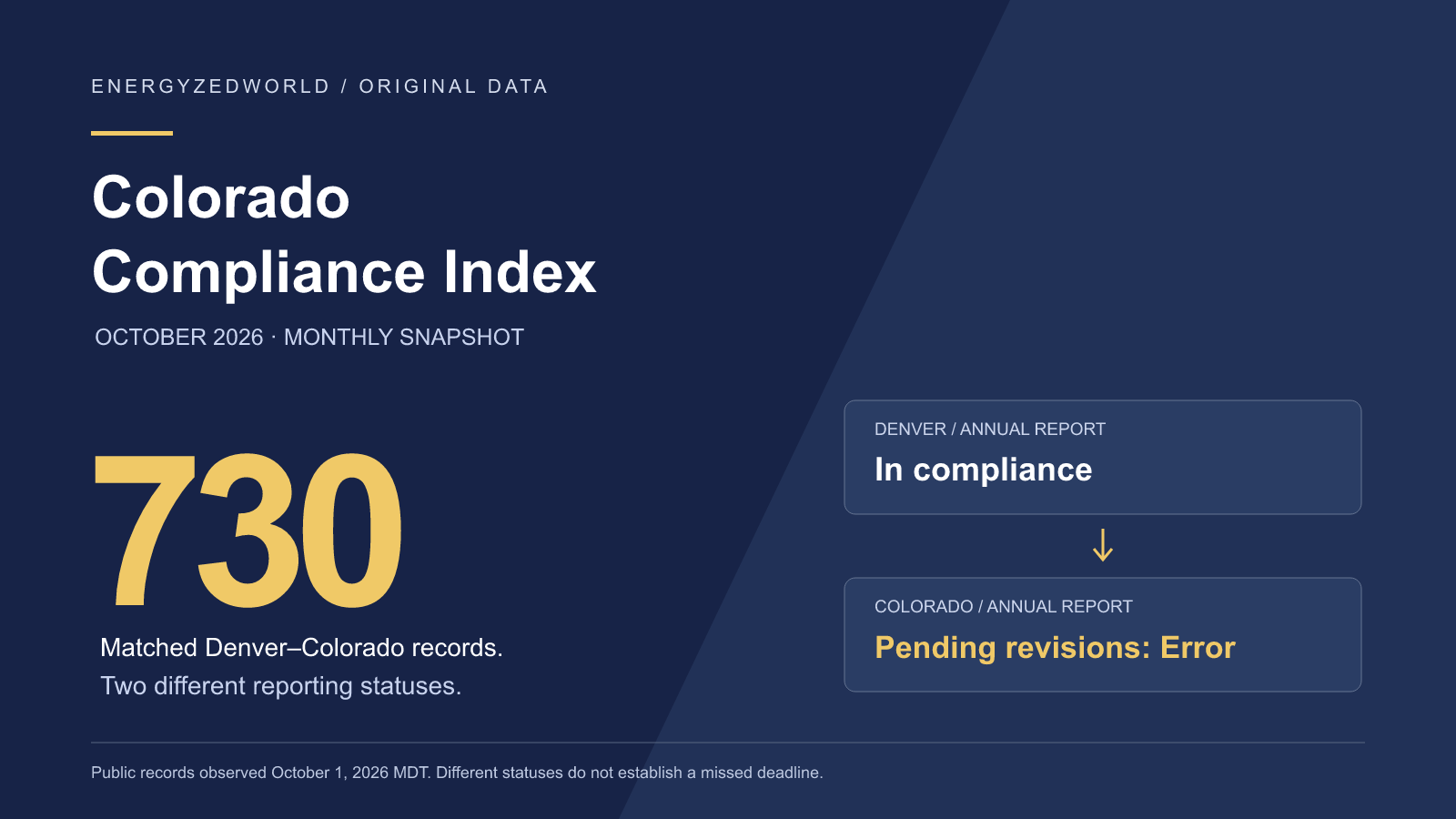
3,032 state records show acceptance. Yet 730 matched Denver records still carry a state pending-error label alongside city acceptance. With Colorado’s November 1 reporting deadline approaching, the practical question is whether both reporting records are complete.
The Colorado Compliance Index calculates report acceptance from official and program-linked public sources. It covers the statewide program, Energize Denver, Boulder, Aspen, Fort Collins and Lakewood. Acceptance is an annual-reporting label; it does not certify legal compliance or achievement of an energy-performance target.
Monthly changes · Jurisdiction guide · Data and methodology · Check your building
Start with Colorado’s 50,000-square-foot program
Building Performance Colorado covers eligible commercial, multifamily and public buildings of 50,000 square feet and larger, subject to program definitions and exemptions. For the 2026 reporting period, 2025 energy data is due November 1. Annual reporting and building-performance obligations are separate. Colorado Energy Office, signed HB25-1269, page 3
Our October 1 export contains the following state public-list records:
| State source status | Records | Interpretation |
|---|---|---|
| In Compliance | 3,032 | The public reporting record shows acceptance. |
| Pending revisions: Error | 7,298 | Check the underlying state record; receipt cannot be inferred. |
| Approved for waiver | 20 | A waiver is recorded. |
| Non-covered | 2 | The source flags the record outside coverage. |
| No published or joined status | 11 | Seven unmatched identities and four null status values. |
| Total list records | 10,363 | The published list, without an extra floor-area filter. |
The report-acceptance rate is 29.3%: 3,032 accepted records divided by 10,341 records after removing 22 explicit waivers and non-covered records. Unknowns remain in the denominator.
Colorado’s filed and not-filed totals remain unavailable. There are zero occurrences of an explicit non-submission label in this joined list, but that does not establish zero non-filers. We never convert the 7,298 pending-error records into a non-filer count. BEAM covered-building list
What changed since September?
Read the denominator changes first. Both editions use state cycle 8 and 2026 city reporting maps. Colorado’s list changed from 10,390 to 10,363 records: 28 IDs entered and 55 left. Explicit exclusions increased from 14 to 22, reducing the rate denominator from 10,376 to 10,341. Unknown statuses fell from 85 to 11. These changes affect the comparison; they are not proof that owners filed, withdrew or became exempt during the interval.
Denver lost one map ID and gained one net exemption, so its denominator fell from 3,037 to 3,035. Boulder’s workbook and Aspen’s covered-address PDF are byte-for-byte unchanged. Boulder and Fort Collins retain the same ID sets and rate denominators. The source review records the verified cycles, map filters and document versions.
| Program | September → October denominator | September → October acceptance | Change, percentage points* |
|---|---|---|---|
| Colorado | 10,376 → 10,341 | 24.8% → 29.3% | +4.5 |
| Denver | 3,037 → 3,035 | 88.2% → 89.0% | +0.7 |
| Boulder | 473 → 473 | 95.1% → 95.1% | 0.0 |
| Fort Collins | 1,292 → 1,292 | 98.0% → 98.3% | +0.3 |
Changes use unrounded fractions before rounding to one decimal, so subtracting the displayed rates can differ by 0.1 point. Different deadlines and source populations make these unsuitable as a jurisdiction league table.
What explains the
459-record acceptance gain?
Label changes and inventory changes in the same reporting cycle.
Among 10,335 state IDs present in both editions, 412 changed from pending revisions to accepted, and 52 changed from unknown to accepted. Six previously accepted records changed to revision or excluded labels. One newly appearing ID was accepted. Together, these observations explain the net increase of 459 accepted records. They are status transitions, not verified dates of submission or correction.
Methodology v1.1 keeps the acceptance formula and coverage filters. It fixes Aspen’s extraction safeguards without changing its published count, records retrieval times by source, rejects new status labels and blank-address matches, and makes unavailable Aspen metrics explicitly null in downloads. September’s files and article source remain unchanged.
Report acceptance, by program.
Same calculation. Different reporting calendars.
A city acceptance is only one record
Matched records.
Different statuses.
Same numeric building ID.
Same normalized address.
The October comparison starts with 1,893 shared numeric IDs between Denver-labeled state records and Denver’s map. Requiring an identical normalized, nonblank address retains 1,488 matches and excludes 405 address mismatches. No fuzzy matching or manual assumptions are used.
Of the 1,363 matched records accepted by Denver, 730 (53.6%) show Colorado’s pending-error label and 633 show acceptance in both systems. Different deadlines and publication timing can produce different labels. This narrow subset is not a representative sample, and the labels do not establish a violation or its cause.
September had 1,489 matches and 804 split-status records. The match populations differ: 1,484 IDs match in both editions, four enter and five leave. Within that shared match set, the split-status count moves from 799 to 728; 83 records with September’s split status now show acceptance in both systems. Other transitions offset part of that improvement. A net decline of 74 in the headline count does not mean exactly 74 owners resolved an issue.
Owner action: keep both building IDs, receipts, revision notices and any required fee evidence together. Confirm each record with its program. Sources: Denver public map, Colorado BEAM, matched records.
Filed, accepted and unavailable are different
For city sources that distinguish receipt and revision, filed at least equals accepted plus pending revisions. It is an observable lower bound, not a complete account of private-portal submissions.
| Program | Listed records | Accepted | Pending revisions | Explicitly not submitted | Excluded | Unknown | Filed at least |
|---|---|---|---|---|---|---|---|
| Colorado | 10,363 | 3,032 | 7,298* | Unavailable* | 22 | 11 | Unavailable* |
| Denver | 3,104 | 2,700 | 83 | 252 | 69 | 0 | 2,783 |
| Boulder | 478 | 450 | 7 | 14 | 5 | 2 | 457 |
| Aspen | 189 addresses† | Unavailable | Unavailable | Unavailable | Unavailable | 189 | Unavailable |
| Fort Collins | 1,362 | 1,270 | 3 | 19 | 70 | 0 | 1,273 |
| Lakewood | Unavailable | Unavailable | Unavailable | Unavailable | Unavailable | Unavailable | Unavailable |
Colorado’s pending-error label does not establish receipt. “Excluded” means an explicit exemption, waiver or non-covered label. The download preserves the underlying counts and a separate nullable not_filed_count.
†Aspen’s PDF has 190 address occurrences and 189 distinct uppercase address strings, with 155 LONE PINE RD repeated. It supplies coverage addresses, not current filing statuses or a certified count of physical buildings.
Do not add these rows into a statewide building total. State and city programs overlap, and maps use different property boundaries and filters.
Which rules apply? Start with size and location
Below 50,000 square feet
doesn’t mean outside the rules.
Statewide
Annual benchmarking
Existing private buildings*
Commercial; multifamily 15,000+
Eligible commercial / multifamily
First report: Dec 31, 2026
Energize Denver: 25,000+ sq ft annual reporting
Covered buildings benchmark annually by June 1. The October public map shows 2,700 accepted / 3,035 after exemptions = 89.0%. Reporting acceptance does not establish that the building has met its applicable performance pathway. Benchmarking requirements
Buildings of 5,000–24,999 sq ft have separate efficiency requirements. The upcoming size-band deadline is December 31, 2026 for 20,000–24,999 sq ft; smaller bands follow in 2027, 2028 and 2029. These buildings are outside the large-building rate above. Small-building requirements
Next action: confirm the size band, report acceptance, verification status and building-specific performance dates. Our September webinar briefing explains the program’s practical steps.
Boulder: 478 listed records, reporting plus other obligations
The official workbook lists 427 private and 51 city records. Its private-building heading specifies June 1, 2026; the city-owned tab specifies May 1. We join 476 IDs to the current map and leave EB427 and EB251 unknown. Acceptance remains 450 / 473 after exemptions = 95.1%. A workbook’s older status column is not substituted for a missing current map label.
BPO covers existing private commercial and industrial buildings from 20,000 sq ft, qualifying new buildings from 10,000 sq ft, and specified city buildings. It also includes assessment, lighting and retro-commissioning obligations. The published schedule includes June 1, 2027 for retro-commissioning measure implementation for the 20,000–30,000 sq ft group. Boulder program and workbook
Next action: check every requirement assigned to the property, including approved extensions—not only annual reporting.
Aspen: coverage is observable; current acceptance is not
Building IQ covers commercial buildings from 5,000 sq ft, multifamily buildings from 15,000 sq ft, and covered city properties. Annual benchmarking is due June 1. The 2026 PDF is unchanged from September: 121 commercial, 46 multifamily and 23 city address occurrences, before exact-address deduplication. Building IQ, 2026 covered list
Aspen says specific performance-standard coverage, timelines and targets remain under development. Its historical participation reporting cannot supply a current 2026 acceptance rate.
Next action: confirm the current annual-report status directly with Building IQ and follow the city’s standards-development updates.
Fort Collins: 98.3% acceptance in the observed map
BEWS generally reaches eligible commercial and multifamily buildings from 5,000 sq ft, with annual reporting by June 1. Published exclusions include multifamily buildings under three stories, row homes, townhomes, industrial and agricultural facilities. Fort Collins BEWS
The required-property map has 1,362 records: 1,270 accepted, 70 exempt, 19 not submitted and three pending revisions. The rate is 1,270 / 1,292 = 98.3%. This is the observed map population, not a certified census of all eligible buildings. Public map
Next action: resolve any submission or revision notice, then use the reporting baseline to investigate operational energy use.
Lakewood: first report due December 31, 2026
Lakewood adopted its benchmarking ordinance on February 23, 2026. Eligible commercial, multifamily and public buildings of 10,000+ sq ft must first report 2025 energy use by December 31, 2026. The program page still displays a draft-rules feedback deadline of September 16, which has passed. City program update
As of October 1, we did not obtain a current public covered-building/status inventory or a final rules publication from the official pages reviewed. Counts remain unavailable. That does not mean zero coverage or a failed program. This phase requires benchmarking; it does not itself require a retrofit.
Next action: organize the 2025 utility data, confirm the property boundary, and use the city’s implementation instructions before the first deadline.
The state list reaches beyond the city programs
The work extends beyond Denver.
Records labeled “Pending revisions: Error” in the state’s 2026 cycle.
The six largest reported-city groups contain 3,924 of Colorado’s 7,298 pending-error records (53.8%). Denver accounts for 1,632; 5,666 fall under other reported city names. These are state-program records grouped by the source city field, not municipal compliance totals or verified city boundaries.
For example, 184 of 261 Lakewood-labeled state records carry the pending-error label. That says nothing about the total population covered by Lakewood’s smaller, 10,000-square-foot local threshold.
Three decisions for October
- Before November 1: confirm whether the state program applies, inspect the 2026 BEAM record, and close any submission or revision issue with the program.
- Before December 31: check Lakewood’s first-report requirement and Denver’s 20,000–24,999 sq ft efficiency deadline where applicable.
- Before choosing equipment: verify meter completeness, floor area and use types. An unresolved reporting label does not diagnose an equipment problem.
The checker is a screening aid with its own refresh date. It does not provide a full local Lakewood lookup or a confirmed Fort Collins covered-building inventory. Use the official program links for those checks and for final status confirmation.
Download and cite this edition
Edition 2 preserves the September baseline and adds the first monthly comparison. Dates describe our retrieval, not the authority’s last update. Public maps can lag owner portals.
- Jurisdiction summary CSV
- Summary JSON
- Monthly changes and shared-record transitions JSON
- Minimal public record IDs and statuses CSV
- Denver–Colorado matched records CSV
- State records by reported city CSV
- Methodology and source URLs
- October source and coverage review
- Source checksums and retrieval timestamps
- October article source
- September archive: article source, data, methodology
Suggested citation: Mbori, Chris / EnergyzedWorld. Colorado Compliance Index, October 2026. Observed October 1, 2026 MDT. Methodology v1.1. Cite this stable article and the dated dataset used.
The state list includes 463 missing floor-area values and 226 values below 50,000 sq ft. We retain them so the denominator represents the published list. These are data-quality flags, not independent coverage determinations. Reporting records can represent properties or campuses; overlapping program counts must never be summed.
Corrections: email Chris Mbori with the jurisdiction, record ID, period and official evidence. AIM Dynamics provides commercial energy services. This is independent analysis, not an official government index.