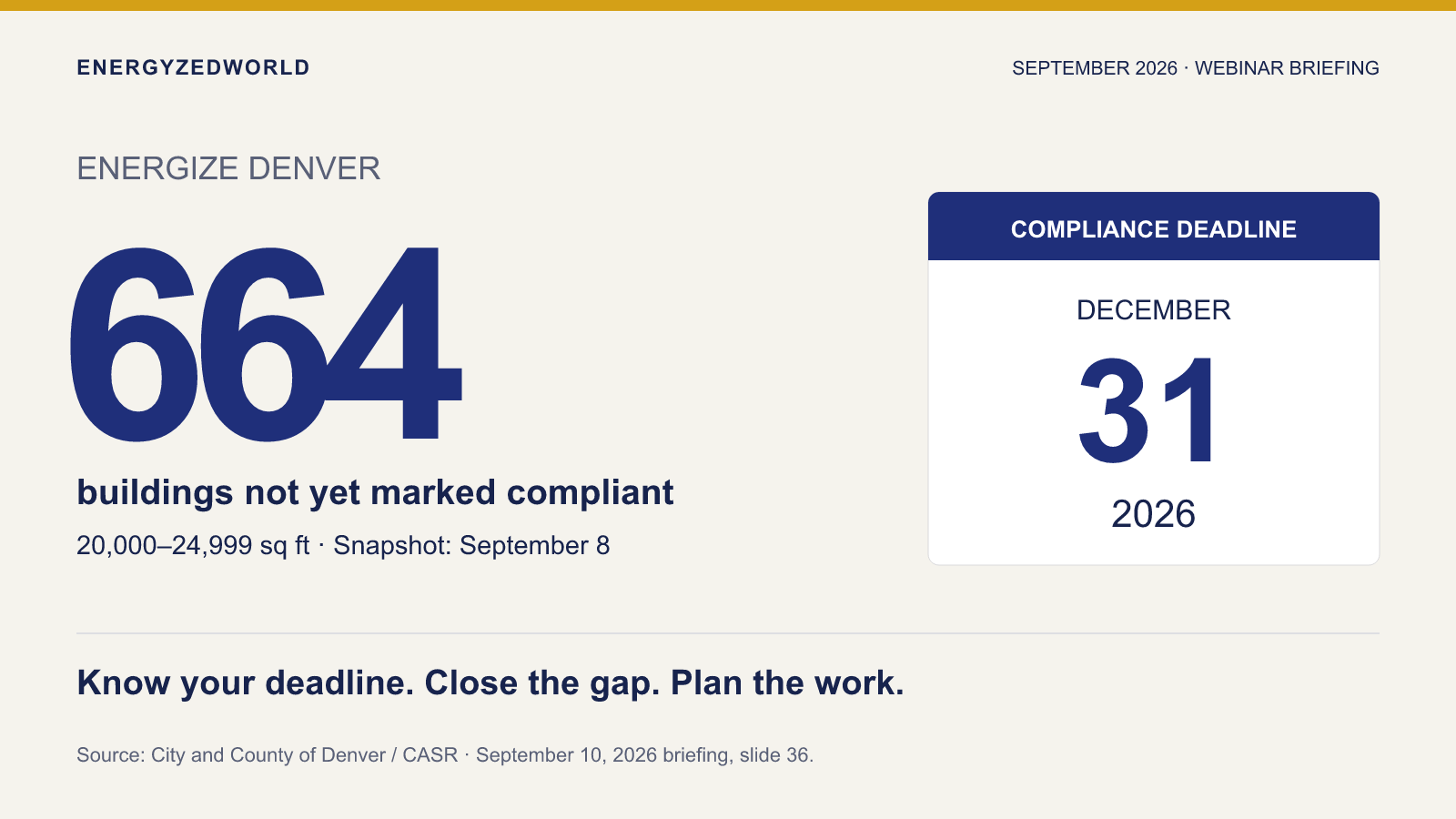
664 Denver buildings in the 20,000–24,999 sq ft band were not yet marked compliant on September 8. Their deadline is December 31, 2026. For larger buildings, the immediate task is different: resolve annual reporting and data-verification issues before they become a longer enforcement problem.
Denver’s September 10 general briefing connected the latest rules to the decisions building teams need to make now: identify the assigned deadline, close reporting gaps, and use the updated flexibility to build an achievable project plan.
This recap uses the city’s presentation and September 1 technical guidance. The numbers are dated webinar snapshots, not a live count of violations. The rules discussed here apply in the City and County of Denver; our Colorado Compliance Index covers the wider state and local picture.
THE BRIEFING IN 70 SECONDS
Know the dates.
Plan the next step.
A short visual recap of the deadlines, reporting gaps and funding decisions covered below.
Watch the Short on YouTube ↗Watch Energize Denver’s full September 10 presentation.
Open the official webinar ↗1. Under 25,000 sq ft: start with your deadline and pathway
not yet marked compliant
About 63% of this deadline group still had a compliance gap. This is a snapshot before the deadline, not a finding that these buildings are overdue.
Source: City and County of Denver, September 10 briefing, slide 36. Calculation: 664 ÷ (391 + 664) = 62.9%.
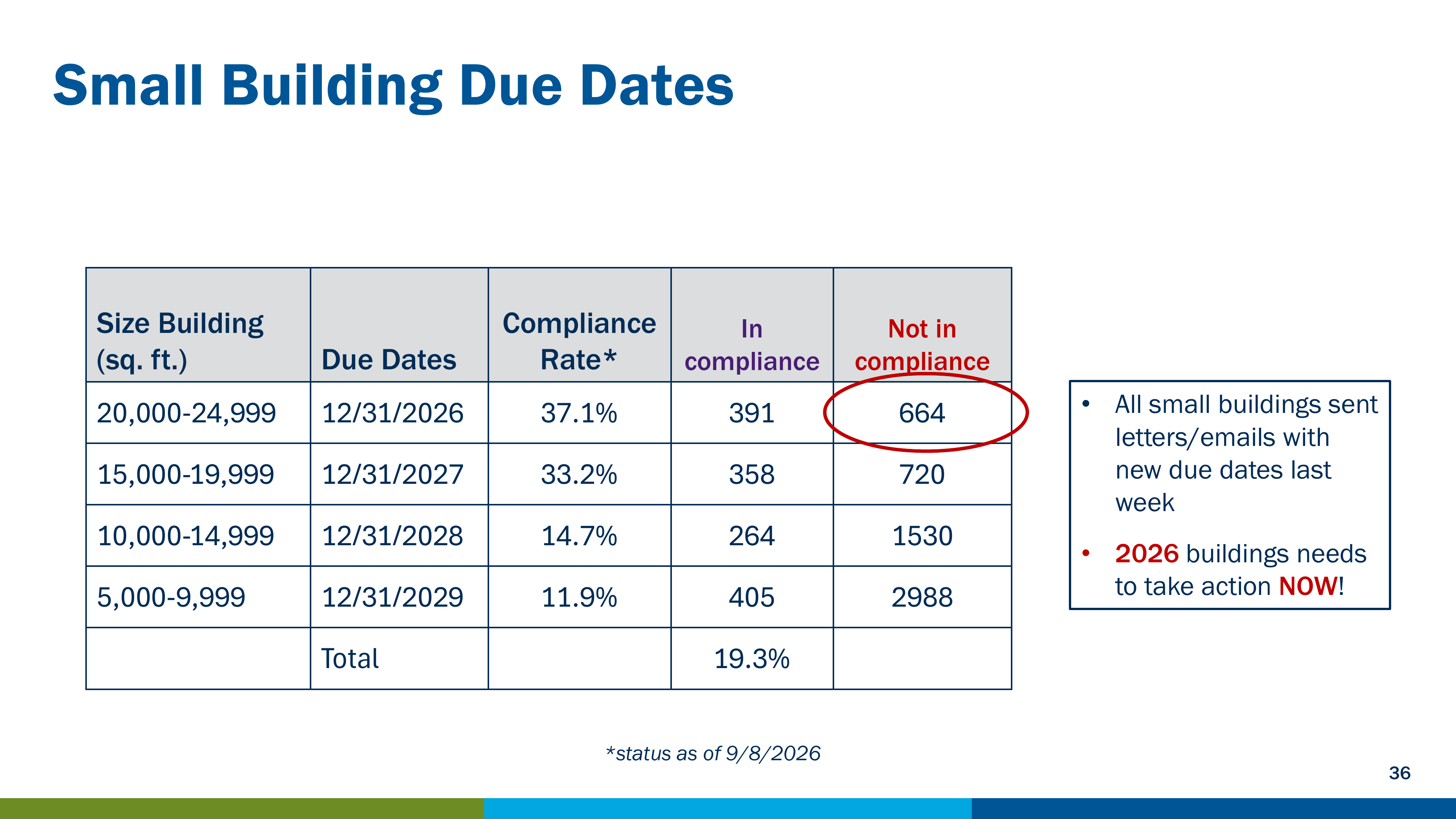
The city reported 391 buildings in compliance and 664 not in compliance in the next deadline group. That means roughly 63% of the 1,055 listed buildings in this band still had a gap to close. It does not mean they had already missed the deadline.
| Gross floor area | Compliance due | In compliance | Not in compliance |
|---|---|---|---|
| 20,000–24,999 sq ft | December 31, 2026 | 391 | 664 |
| 15,000–19,999 sq ft | December 31, 2027 | 358 | 720 |
| 10,000–14,999 sq ft | December 31, 2028 | 264 | 1,530 |
| 5,000–9,999 sq ft | December 31, 2029 | 405 | 2,988 |
Source: briefing slide 36; status as of September 8, 2026. Later deadline groups should plan ahead; these counts do not establish overdue violations.
 Enlarge original slide ↗
 The next decision is the right compliance pathway. A lighting professional can document at least 90% LED lighting load or 97% LED fixtures. Owners already meeting the requirements may use the documented self-verification route. Other options address renewable energy, an estimated 15% energy reduction, qualifying restaurant improvements, residential-condominium common areas, or eligible heating-equipment electrification. Each has its own evidence requirements. Small-building guidance, sections 3–4
Practical move: confirm your size and assigned deadline, inventory what already qualifies, and agree on the submission documents before commissioning work. In a mixed-use property, ask the Help Desk about combining different tenant pathways into one building submission.
2. At 25,000+ sq ft: check reporting and verification separately
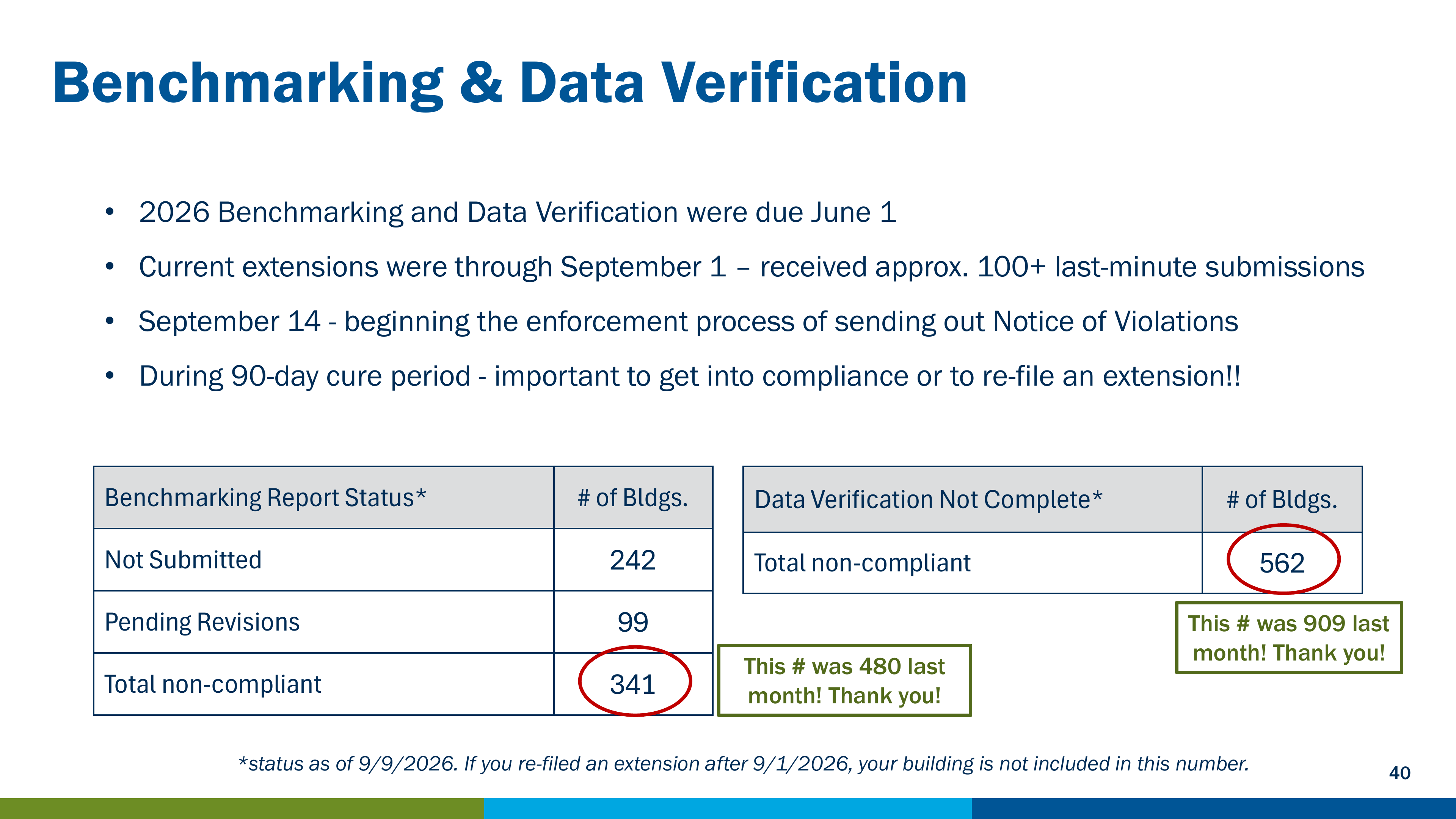
Benchmarking unresolved
242 not submitted
99 pending revisions
Data verification incomplete
A separate requirement to check
with your reporting team.
Check both statuses. The groups may overlap; these figures cannot be added into a count of unique buildings.
Source: briefing slide 40. The city excluded buildings that re-filed an extension after September 1 from these figures.
There was progress: the city’s unresolved benchmarking count fell from 480 to 341, while incomplete verification fell from 909 to 562 compared with the previous month’s figures. But an accepted benchmarking report and completed data verification remain separate checkpoints.
The webinar said 2026 benchmarking and data verification were due June 1, with then-current extensions through September 1. Denver announced it would begin sending Notices of Violation on September 14, 2026. That is an announced start to notices, not a same-day fine for every building.
 Enlarge original slide ↗
 Practical move: have your reporting team check submission acceptance, verification completion and extension status in the Energize Denver Management Portal. If you receive a notice, work from its dates and required actions. The guidance provides a 90-day cure period to address the issue or pursue the applicable extension or corrective process. Large-building guidance, section 10.1
3. A 2028 target belongs in the 2027 project plan
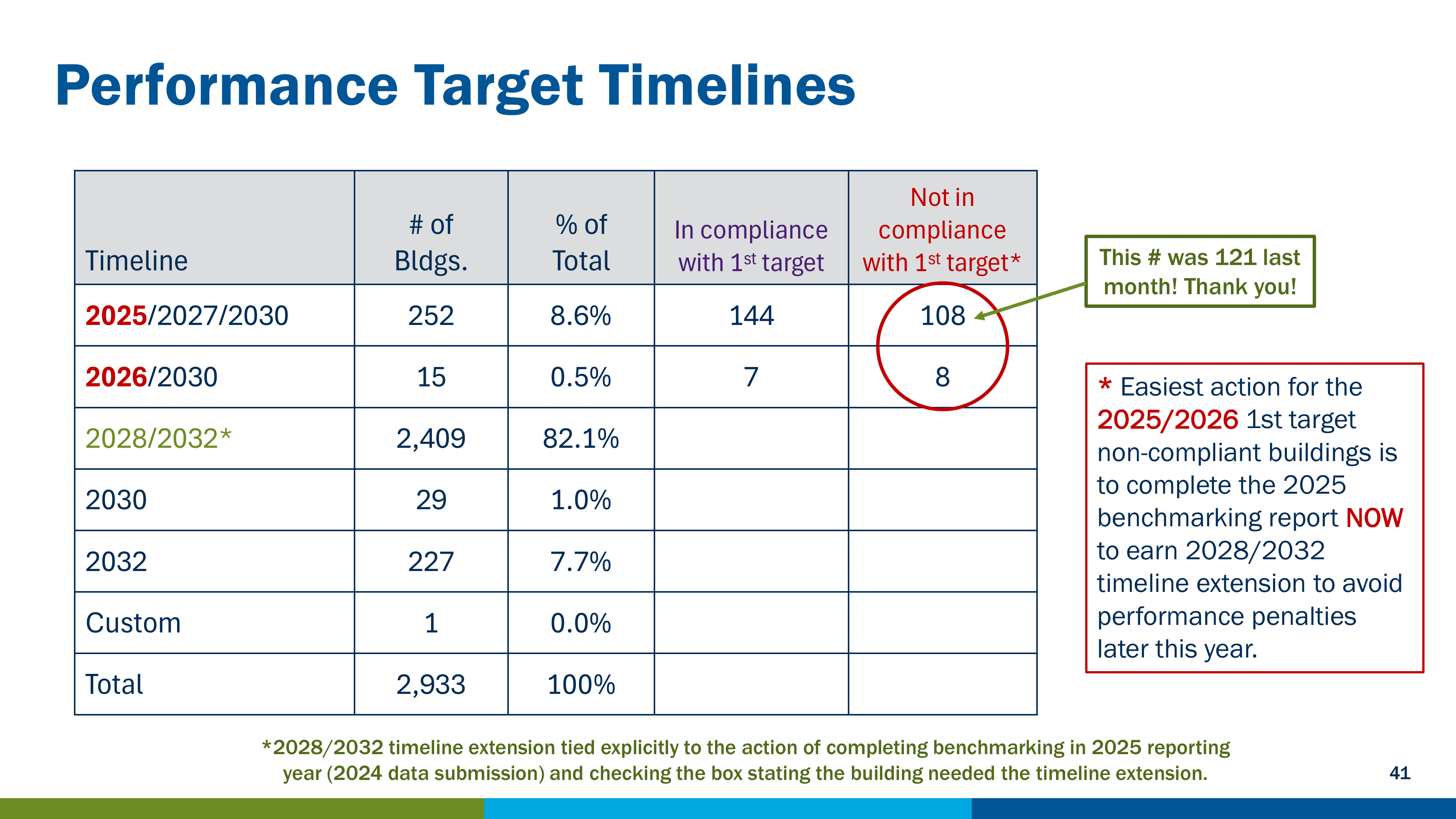
Denver reported that 2,409 of 2,933 large buildings—82.1%—were on the 2028/2032 timeline. Other buildings had earlier or different assigned timelines.
See the city’s original performance-timeline slide
 Enlarge original slide ↗
 Do not assume the 2028/2032 shift is already on your record. The city tied it to completing the 2025 reporting-year submission—2024 energy data—and opting in to the extension. That is a different filing from the 2026 report discussed above. Large-building guidance, section 7.2
2028 measures the result.
2027 is when the work pays off.
Verify data, confirm the target and arrange funding.
Aim to finish improvements before the measurement year.
Capture a full calendar year of improved energy performance.
Submit 2028 energy data by June 1, subject to approved extensions.
Planning interpretation based on Denver’s audit-rebate guidance and large-building technical guidance, section 8.1. Confirm the timeline assigned to your building.
The useful planning distinction is measurement year versus construction year. Improvements completed during 2027 can contribute savings throughout 2028. Waiting until late 2028 gives the building only a partial year of benefit in that year’s energy data. Denver makes this point in its audit-rebate guidance.
4. Use the new flexibility with a documented plan
The briefing clarified four decisions worth raising with your engineering team:
| Decision | What to check |
|---|---|
| Target adjustment | Whether your building qualifies for a target adjustment or an audit-supported maximum 30% reduction target. This is an application route, not a universal requirement or automatic cap. |
| Capital planning | A capital-cycle extension can align work through 2036 with a 2037 measurement period. Standard extensions carry near-term requirements; document the selected measures or justified exception. |
| Condominiums and specialist buildings | Condo eligibility depends on size and mechanical configuration. Restaurants and manufacturing, agricultural or industrial buildings have specific provisions. Do not apply one pathway to every property. |
| A sale or management handover | Include compliance status, approved notices and reporting records in due diligence. For covered large buildings, the seller must transfer the Portfolio Manager property and associated data. |
These points come from briefing slides 15–24 and the large-building technical guidance. Our 2026 rules guide explains the pathways in more detail.
The performance policy does not impose a blanket requirement to electrify, replace HVAC before the end of its service life, or cut every building’s energy use by 30%. The building’s actual target and approved pathway should guide investment.
5. Put December 15 on the funding calendar
Denver’s energy-audit rebate pre-approval deadline is December 15, 2026. The program supports eligible ASHRAE Level 2 or higher audits for covered buildings of at least 25,000 sq ft. Published rebate amounts are $5,000 for 25,000–50,000 sq ft, and $2,500 plus $0.05 × total building sq ft for buildings over 50,000 sq ft, capped at $30,000.
Eligibility exclusions and funding limits apply; get the program’s pre-approval to reserve funds. Qualifying past audits may also be eligible. Check Denver’s current audit-rebate terms and apply.
Your next building meeting: three decisions
- Facility manager: confirm the building ID, size, assigned timeline and open reporting items.
- Engineer or benchmarking provider: verify the data, quantify the performance gap and document the suitable pathways.
- Owner or asset manager: approve a budget, name a responsible person and set dates for submissions, funding and implementation.
Start with the Energize Denver Management Portal and the official forms and guidance. Bring the building’s assigned timeline, accepted submissions and outstanding questions to the next meeting. For the complete city presentation, watch Energize Denver’s official September 10 webinar.
Webinar and source documents
- Watch the city’s September 10 recording.
- Energize Denver Navigation Center and official forms and guides.
- Small-building technical guidance, September 1, 2026.
- Large-building technical guidance, September 1, 2026.
Slides reproduced from the City and County of Denver / CASR’s September 10, 2026 general briefing supplied by the attendee. Original charts and interpretation: EnergyzedWorld. Official web guidance checked September 12, 2026. This is an independent webinar recap; the city’s notices and approved building-specific decisions govern.