
Colorado’s $13.9 million industrial emissions awards show how public support can move equipment upgrades and carbon management toward implementation. As of October 2026, the announced round covers seven recipients. My engineering takeaway is straightforward: define the operating problem, choose the right intervention, and establish how its performance will be measured.
A refrigeration system approaching replacement. A printer drawing more electricity than it needs. A site paying heavily for short peaks in demand.
Those are familiar conversations for an energy manager. What makes this announcement interesting is the opportunity to turn those conversations into investment decisions.
The funding gets my attention. What happens after installation will hold it.
First, understand what the money represents
The Colorado Energy Office’s October 21 announcement separates Clean Air Program (CAP) grants from refundable Colorado Industrial Tax Credit Offering (CITCO) tax credits. That distinction matters when planning a project’s cash flow.
I would want the finance and engineering teams working from the same schedule: when the equipment must be ordered, when invoices fall due, and when support can actually be realized. A headline award amount cannot answer those questions for another facility.
Nor does an award establish the total installed cost, the owner’s contribution or the eventual payback. Those need project-specific evidence.
Who received the awards?

| Recipient | Award | Planned work |
|---|---|---|
| TPSR Solar 16 LLC | $1,055,738 CITCO | Industrial battery storage, Weld County |
| Underground Manufacturing LLC dba Vertpack | $360,627 CITCO | Efficient printing, Longmont |
| Charm Industrial Inc. | $8,000,000 CITCO | Biomass-to-bio-oil storage, Fort Lupton |
| New Belgium Brewing Company Inc. | $699,595 CITCO | Refrigeration replacement, Fort Collins |
| Origen Carbon Solutions Inc. | $1,000,000 CITCO | Lime-facility design study, Windsor |
| Grand Valley Instrumentation | $101,400 CAP | Landfill methane detection |
| Vycarb | $2,713,200 CAP | Wastewater carbon management |
Award details: Colorado Energy Office announcement. The CAP providers will secure implementation sites. Origen’s award is for a study; it is not confirmation that the proposed facility has been built.
The factory floor is where I would start
For an industrial operator, the most useful part of this story may be the equipment already on the replacement list.
A refrigeration replacement is an opportunity to ask more than whether the new machine has a better efficiency rating. What cooling duty must it deliver? How does the load vary? What happens during low production? Can the controls keep it operating efficiently across those conditions?
For printing or other production equipment, I would look at energy per unit of saleable output alongside total consumption. A plant can use more electricity because it is producing more, while becoming more efficient at the same time. Scrap and rework also deserve attention: energy spent on unusable product still lands on the bill.
Battery storage asks a different set of questions. I would examine interval demand, the tariff, the duration of the peak and the loads that need backup. A battery can shift when a facility buys electricity, but its charging losses still need to be included. Lower demand charges and lower energy consumption are separate outcomes.
The best project case connects the equipment to the operating problem it solves.
Carbon management needs its own evidence
The carbon projects widen the discussion beyond electricity bills.
Grand Valley Instrumentation describes landfill monitoring and control technology designed to improve gas capture. Vycarb describes water-based carbon storage and direct sensing. Origen describes a platform built around zero-emission lime. These are the companies’ descriptions of their technologies, not independent verification of the newly funded work.
My questions would follow the physical process. What is being measured? Where is the boundary? What energy does the intervention require? How is the claimed reduction or storage independently checked?
The answers will differ between methane management, manufacturing efficiency and carbon storage. An electricity meter can help verify an electrical load. It cannot, on its own, establish how much carbon has been permanently stored.
Before approving the next project, agree on the proof
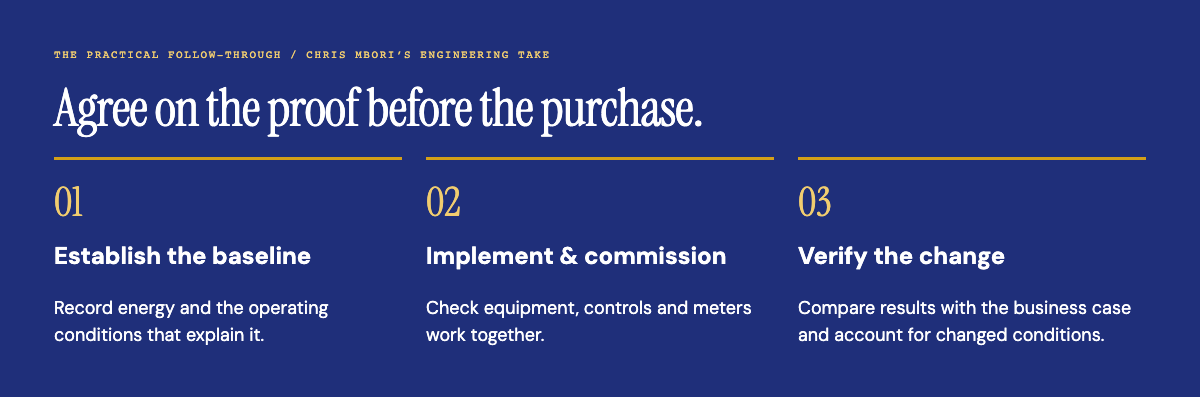
I would put these five items into the project brief before approval:
- The problem. Name the cost, reliability issue, waste stream or emissions source being addressed.
- The baseline. Record the relevant consumption and operating conditions before the change.
- The boundary. Decide which equipment and energy flows the claim includes.
- The commissioning plan. Check that equipment, controls and meters work together as intended.
- The review date. Assign someone to compare actual performance with the business case.
For a production line, that comparison may need to account for throughput and product mix. For refrigeration, cooling duty and ambient conditions may matter. For storage, dispatch records and tariff calculations may be central.
A dashboard is useful when it helps the team answer those questions and act. The value comes from the operating decision that follows.
Field note
My reading of these awards is a reminder to bring engineering and finance into the same conversation early. Equipment condition, operating data, funding timing and the measurement plan all influence whether a project makes sense.
For an owner reading this from Colorado or East Africa, I would start with the same exercise: pick one recurring operating problem and assemble the evidence needed to make a decision. The available funding will differ. The discipline of defining and measuring the opportunity still applies.
Which energy improvement at your facility is ready for a serious business case?
Sources
- Colorado Energy Office: October 21, 2026 award announcement, distributed unaltered by Public Technologies. Source for all recipient amounts and award scopes.
- Grand Valley Instrumentation: landfill gas management. Company description of its monitoring and control approach.
- Vycarb: carbon capture, storage and sensing. Company description of its technology.
- Origen: zero-emission lime and carbon management. Company description of its technology platform.
Visual credits: Governor Jared Polis archive portrait, January 2016, US House Office of Photography, public domain, via Wikimedia Commons. Company logos identify award recipients; their inclusion does not imply endorsement. TPSR Solar 16 LLC is shown by name because a verified logo was not located. Vert is the current branding on Vertpack’s website.
