As of October 2026, Longmont is building an on-bill financing program that will let homeowners and small-rental owners pay for energy upgrades through a fixed monthly charge on their city utility bill instead of paying upfront. City Council voted 5–2 on 6 October 2026 to approve the framework, covering efficiency, electrification, weatherisation, renewables, storage and water-conservation upgrades, but enrolment is not open yet: the lender, loan limits, interest rate and terms are still to be set.
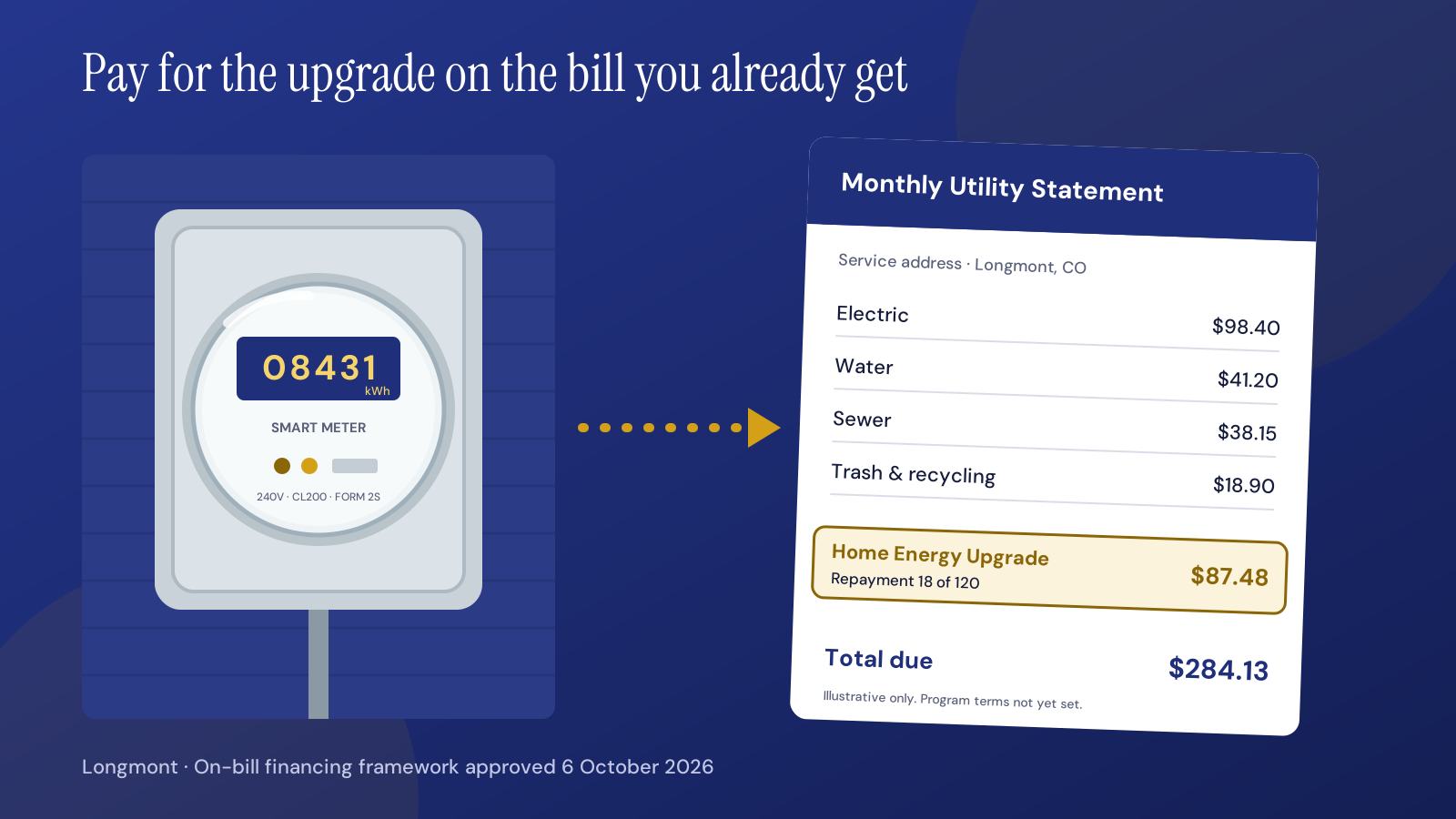 The idea in one picture: the upgrade is paid back on the bill you already receive. Figures are illustrative.
What on-bill financing is
The cost of an energy upgrade is paid up front by the utility, or by a lender working with it, and you repay it in fixed monthly instalments that appear as a separate line on your regular utility bill.
That is the whole mechanism. What makes it useful is what it removes:
- No upfront cash. The project is financed from day one.
- No new bill to manage. The repayment sits beside your electric and water charges.
- A repayment matched to savings. A well-designed upgrade lowers energy use, which offsets some or all of the monthly charge.
The Environmental and Energy Study Institute (EESI), the main national resource on these programs, groups them into two families:
| Model | Who owes the money | What happens if you move |
|---|---|---|
| On-bill loan | The customer who signed the agreement | Typically paid off when you sell or close the account |
| Tariff-based (meter-attached) | The charge stays with the meter | The next customer at that address continues paying |
EESI also argues for bill neutrality: the monthly repayment should be roughly equal to, or less than, the energy savings, so the household is not worse off month to month while it pays for the upgrade.
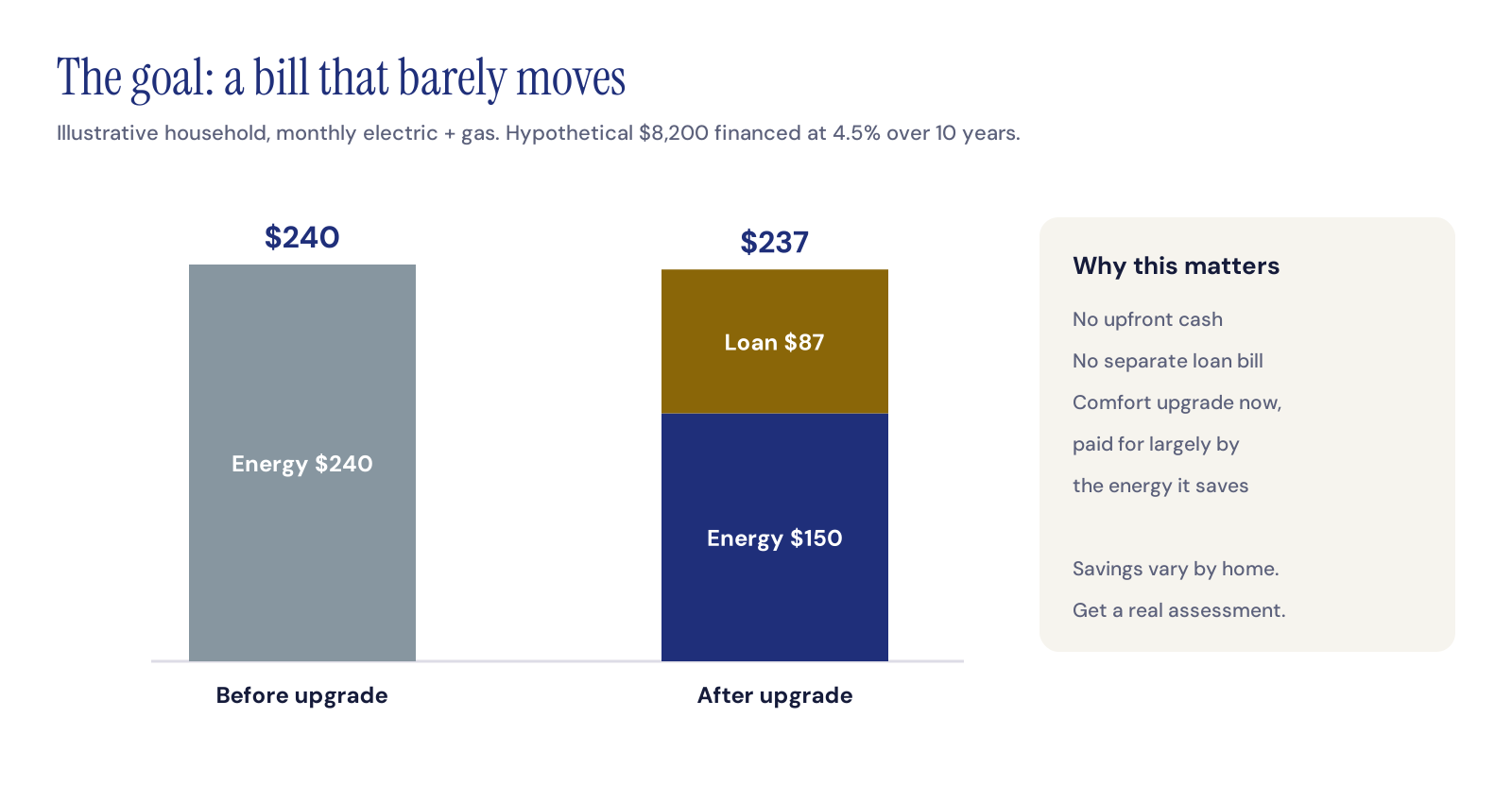 Bill neutrality, illustrated. Actual savings depend on the home, the measures and the quality of installation.
This is not experimental. EESI has identified at least 50 electric co-ops in 23 states with current or recent residential programs, and at least 15 public utilities in eight states. The model suits municipal utilities in particular, because the city already sends the bill, already holds the customer relationship and already has a collections process. That describes Longmont exactly.
The proof next door: Fort Collins Epic Homes
Fort Collins Utilities launched its first on-bill program in 2012 and relaunched it as Epic Homes in 2018. The Epic Loan now lets Fort Collins Utilities customers borrow up to $50,000 for efficiency, electrification, solar and battery upgrades, repaid on the monthly utility bill. Eligible homes include single-family and attached homes, including rentals of four units or fewer.
The track record is the headline: EESI reports that Fort Collins’ on-bill programs issued 211 loans totalling about $2.28 million with no defaults.
Three design choices made it work:
- Long-term capital. The city secured 15-year loan agreements with Vectra Bank and the Colorado Energy Office for up to $3.25 million, which keeps monthly payments low.
- Rebates first, financing second. Every financed project must qualify for a rebate and be approved by the utility.
- Quality control through Efficiency Works. Customers start with an Efficiency Works assessment and use registered contractors.
Longmont is well placed to copy this. Longmont Power & Communications already shares the Efficiency Works program with Fort Collins, Loveland and Estes Park, so the assessment process, contractor network and rebate structure behind Epic Homes already serve Longmont customers.
What Longmont approved on 6 October 2026
Based on the adopted ordinance as reported from the 6 October council meeting:
What can be financed. City-approved energy-efficiency, electrification, weatherisation, renewable-energy, energy-storage and water-conservation improvements installed at a service address at the customer’s request. Including water conservation and storage makes it broader than many programs.
Who can apply. Utility customers at:
- single-family homes
- duplexes and attached homes
- condominiums
- rental properties with four or fewer units
Applicants must be current on their utility charges. Where a tenant holds the utility account, the property owner must first obtain the tenant’s written consent. Participation also depends on eligibility and available funding.
How repayment works. Repayments will appear as a separate, clearly labelled charge on the regular utility bill and may include principal, interest and a city administrative fee. A financing agreement will set the amount, interest rate, term and monthly payment.
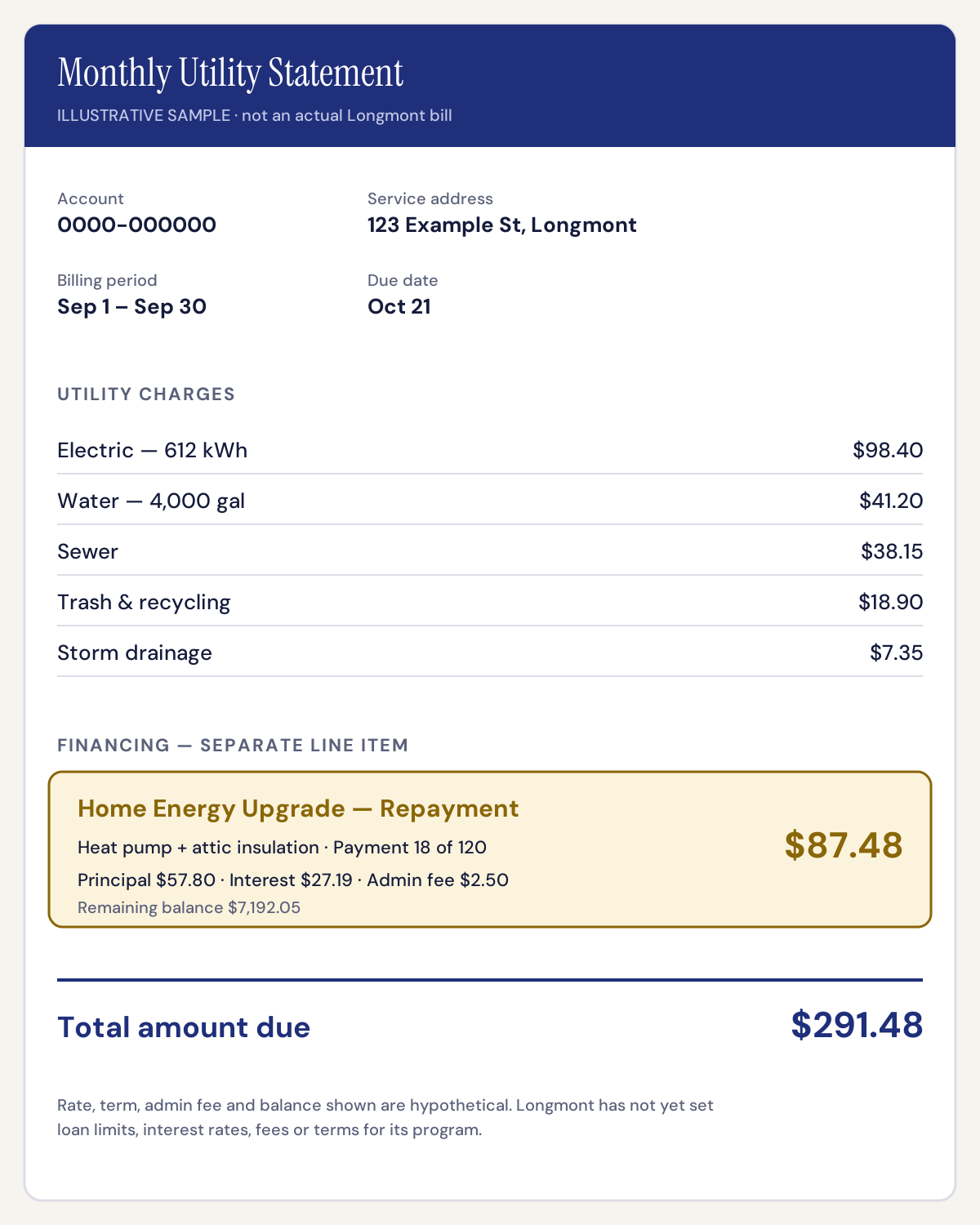 What a repayment line could look like. Every number is hypothetical, and this is not an actual Longmont bill.
It is voluntary. Participation is not a condition of utility service, and the ordinance provides for confidentiality of customer information to the extent allowed by law.
What has not been decided yet
Enrolment is not open. The vote authorised a framework; city staff still have to design the program. As of October 2026 the city has not selected a lender or administrator, and has not set:
- program funding
- loan limits
- interest rates
- terms
- detailed application criteria
Anyone offering today to finance a project “through Longmont’s new program” is ahead of the facts.
The caveat: missed payments and disconnection
The vote was not unanimous, and the two council members who opposed it raised a fair point. Under the ordinance, repayments for city-provided financing may be subject to the city’s collection procedures and service discontinuance, with applicable notice. In plain terms, missing the upgrade payment could eventually put your electric or water service at risk, the same way missing the rest of the bill can.
For third-party financing the city’s collection and disconnection rules do not apply to the repayment, and the city is not responsible for money owed to the lender.
This is not unusual. Fort Collins Utilities retains the same authority under its municipal code, and its program has recorded no defaults. It is still a reason to size a loan conservatively and treat bill neutrality as a requirement, not a hope.
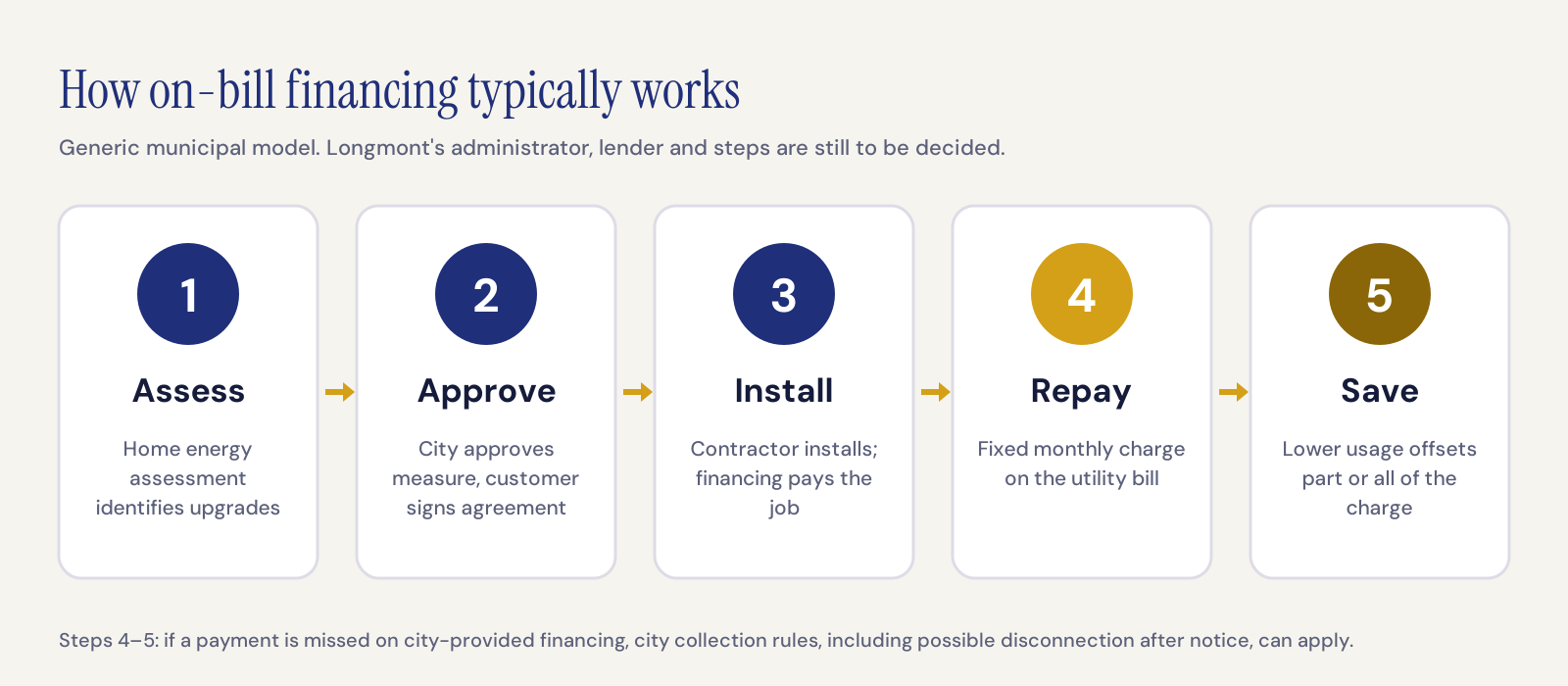 The usual sequence in municipal programs. Longmont’s specific steps will be set when the program is designed.
Why this is a good move for Longmont homes, and what to do now
Done well, on-bill financing does things a rebate cannot do on its own:
- It reaches households rebates miss. A $2,000 rebate on a $14,000 heat pump project still leaves $12,000 to find. Rebates help households that already have savings; financing helps everyone else.
- It can lean on payment history. Programs that weigh bill-payment history alongside, or instead of, credit scores open the door to households a bank might turn away. Longmont’s “current on utility charges” requirement points that way; the final criteria will tell.
- It brings rentals into scope. Covering rentals of up to four units, with tenant consent, gives owners a practical way to upgrade homes where energy waste is often worst.
- It keeps money and work local. The utility, the rebate program, the contractors and the savings all stay in Longmont.
What to do before enrolment opens:
- Get an Efficiency Works assessment. It is the likely first step in any future program and tells you which upgrades pay back in your home.
- Pull twelve months of utility bills. You cannot judge bill neutrality without a baseline.
- Line up your rebates. Efficiency Works offers rebates on heat pumps, heat-pump water heaters, insulation and more, including a bundling bonus for heat pump plus envelope work. Rebates reduce how much you need to finance.
- Stay current on your utility account. It is an eligibility requirement in the ordinance.
- Landlords: talk to tenants now. Written tenant consent will be required where the tenant holds the account.
- Watch for the program terms. When the rate, term, loan limit and fee are published, run your own payment against your own savings before you sign.
New to heat pumps? Start with how heat pumps work, or browse the Energy Financing hub.
Sources
- Longmont approves framework for financing home energy upgrades through utility bills — The Badger, 10 October 2026
- City of Longmont agenda management portal (adopted ordinance) — City of Longmont
- On-Bill Financing FAQ — Environmental and Energy Study Institute
- Fort Collins Epic Homes case study — Environmental and Energy Study Institute
- Epic Loan — City of Fort Collins Utilities
- New 15-year financing for Epic Homes — City of Fort Collins Utilities
- Home rebates and incentives — Efficiency Works