Electrical reliability testing is not one job — it’s four. You verify a circuit is safe and wired correctly before touching it, you measure what’s flowing right now, you log energy over days and weeks to see the pattern, and you confirm the condition of the assets — insulation, connections, transformers — before they fail on their own schedule. AEMC Instruments (the US arm of France’s Chauvin Arnoux Group, making test gear since 1893) builds a tool for each of those jobs, and Aim Dynamics stocks 14 of them. This guide walks the whole lineup job by job — what each instrument answers, what it costs as of July 2026, and honest buy-it-when advice — because the right question is never “which meter is best,” it’s “which question is my facility failing to answer.”
(Disclosure: we work with Aim Dynamics commercially — they supply the metering hardware behind much of our monitoring work. Prices below are theirs, as of July 2026.)
Four jobs, fourteen instruments
Since 2023, this stopped being a philosophical framework. NFPA 70B — Standard for Electrical Equipment Maintenance — was converted from a recommended practice (“should”) to a standard (“shall”), which means US commercial and industrial facilities are now expected to run a documented, condition-based electrical maintenance program. Condition-based maintenance runs on measurements, and measurements run on instruments. Here’s how the AEMC lineup maps to the four jobs:
| Job | Question it answers | AEMC instruments |
|---|---|---|
| Verify | Is it energized? Is it wired right? | 275HVD voltage detector, 6611 phase rotation meter |
| Measure | What’s flowing right now? | 5233 multimeter, 514 and 404 clamp meters |
| Log | What’s the pattern over time? | PEL 113 logger + MiniFlex, AmpFlex, MN193 sensors |
| Confirm condition | Will this asset survive the year? | 1060 megohmmeter, 6240 micro-ohmmeter, 8511 turns ratiometer |
Job 1: Verify — is it safe, and is it wired right?
Everything starts here, because the two cheapest instruments in the lineup prevent the two most expensive kinds of mistake.
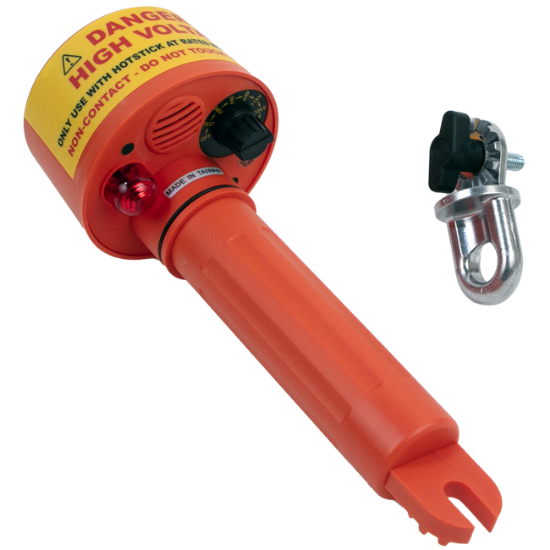 The 275HVD detects voltage from 240 V up to 275 kV without contact — the “is it actually dead?” check.
The Model 275HVD Non-Contact High Voltage Detector ($349) confirms presence or absence of voltage from 240 V all the way to 275 kV without touching the conductor, with a manual self-test to prove the detector itself is working before you trust it. It is a verification tool, not a measurement tool — it tells you whether, not how much — and it belongs in the pocket of anyone who opens gear above panelboard level.
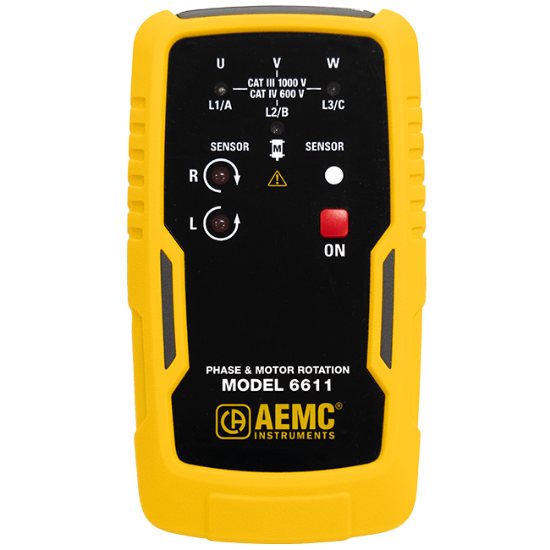 The 6611 confirms phase sequence and motor rotation direction before you couple the load.
The Model 6611 Phase & Motor Rotation Meter ($109) answers a question that ruins equipment when guessed: which way will this motor spin? Swap any two phases on a replacement motor, a generator hookup or a rewired panel, and pumps run backwards and compressors slug. The 6611 confirms phase sequence and — without even coupling the motor — rotation direction. It’s the cheapest item in the lineup and arguably the highest ratio of damage-prevented to dollars-spent.
Job 2: Measure — the clamp meter vs multimeter question
The single most-searched question in this equipment class is “clamp meter vs multimeter — which do I need?” The honest answer: they answer different questions, and a facility needs both.
- A multimeter measures by contact through its leads: voltage, resistance, continuity, capacitance, and small currents. It answers “what’s the voltage/resistance here?”
- A clamp meter measures current through the magnetic field around a conductor — no contact, no circuit interruption, and it handles hundreds of amps. It answers “how much is this circuit carrying right now?”
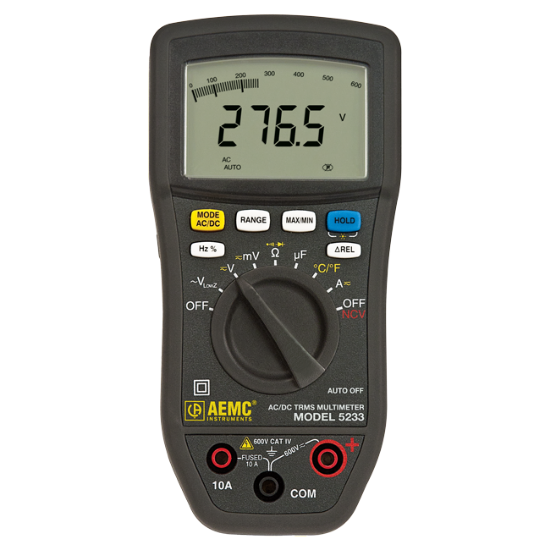 The 5233: TRMS, 6000 counts, with non-contact voltage detection built in.
The Model 5233 Digital Multimeter ($125) is the panel-diagnostics side: TRMS (which matters — averaging meters misread the distorted waveforms that VFDs and LED drivers produce everywhere now), 6000 counts, AC/DC volts and amps, capacitance, temperature and non-contact voltage detection in one handheld.
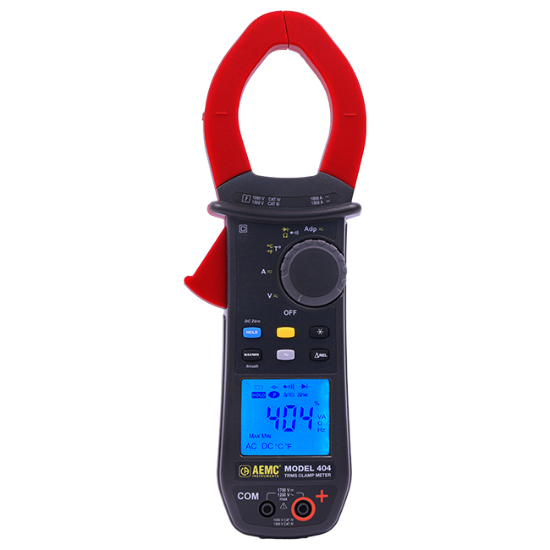 The 404 clamp: 1000 A AC / 1500 A DC without breaking the circuit.
On the clamp side there are two tiers. The Model 514 Clamp-on Meter ($230) covers AC/DC TRMS to 1000 A with frequency, resistance and continuity — the everyday load-check clamp. The Model 404 Clamp-on Meter ($489) stretches to 1500 A DC and 1700 V DC — numbers that matter if you’re working around larger commercial solar and battery DC buses, where ordinary 600 V clamps are out of their depth.
Job 3: Log — the PEL 113 and the case for time-series over spot readings
A spot reading tells you what a circuit was doing the second you clamped it. It cannot tell you the base load at 3 a.m., the Monday-morning demand spike, or which phase is quietly running 20% heavier than the others. For that you log — and this is where the AEMC lineup earns its place in an energy-monitoring blog.
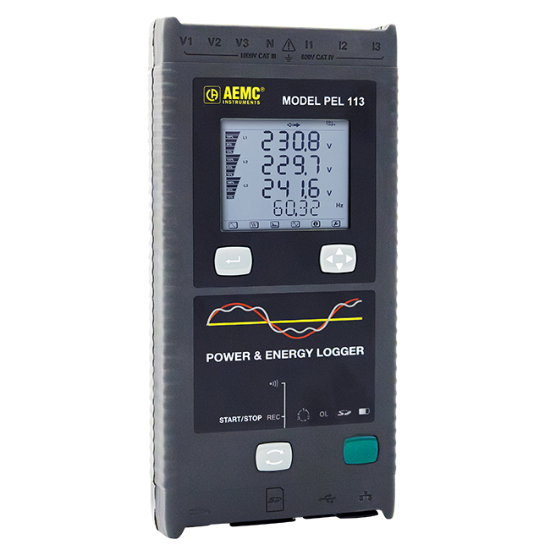 The PEL 113: three voltage and three current channels, LCD, magnetic mount, weeks of recording.
The Model PEL 113 Power & Energy Logger ($2,990, including three MiniFlex sensors and DataView software) is the workhorse. It records voltage, current, power (W, VA, VAR), power factor and energy on all three phases, mounts magnetically inside the panel, and offers USB, Ethernet and Wi-Fi for retrieval. Auto-recognition of connected sensors kills the classic setup error of telling the logger the wrong CT ratio. This is the instrument that turns “we think the compressor is the problem” into a stamped, time-series fact — the data a lighting retrofit M&V, a solar sizing, a transformer loading study, or a demand-charge dispute actually runs on.
One distinction worth being clear-eyed about: the PEL 113 is a power and energy logger, not a power quality analyzer. It tells you where the energy goes and when. If you’re chasing waveform-level events — transients, sags, harmonics detail — that’s a different (and much more expensive) class of instrument. Most facilities need the energy picture first.
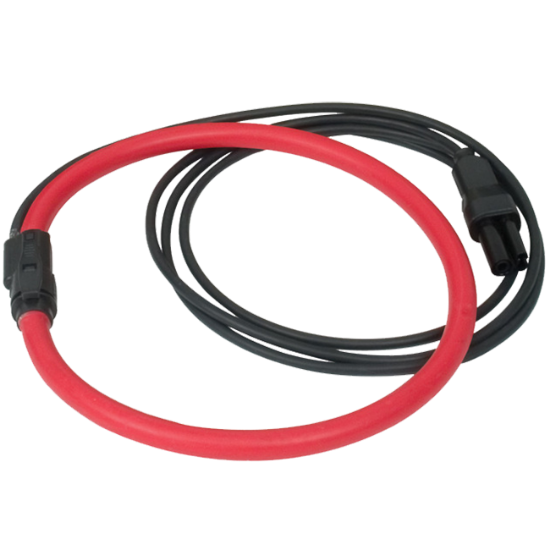 AmpFlex: a Rogowski coil that loops around bus bars and paralleled conductors no rigid clamp can swallow.
The logging job is really a small ecosystem, and the sensor choice matters as much as the logger:
| Sensor | Price | Buy it when |
|---|---|---|
| MA193-10-BK MiniFlex 10” | $290 | Default for crowded panels — flexible, never saturates |
| 193-24-BK AmpFlex 24” | $335 | Large bus bars and paralleled conductor sets, 100/1000 A ranges |
| MN193-BK AC Current Probe | $353 | Small loads — resolves down to milliamps where a Rogowski coil is noisy |
| Power-to-Phase Adapter 600 V CAT III | $399 | Powering the PEL safely off the phases you’re measuring — no hunting for an outlet in the switchroom |
The flexible sensors are Rogowski coils: AC-only, but linear across an enormous range and able to fit where iron-jaw clamps physically can’t. On real panel-logging jobs, that fit is the difference between installing in ten minutes and not installing at all. And if the logging job outgrows portable instruments — when you want permanent circuit-level visibility instead of a two-week snapshot — that’s the point where a fixed data acquisition system like the ADM Director takes over from the PEL.
Job 4: Confirm condition — the tests a multimeter cannot do
This is the job NFPA 70B-2023 turned from good practice into obligation, and it’s the job where people most often reach for the wrong instrument. Three condition tests, three dedicated tools:
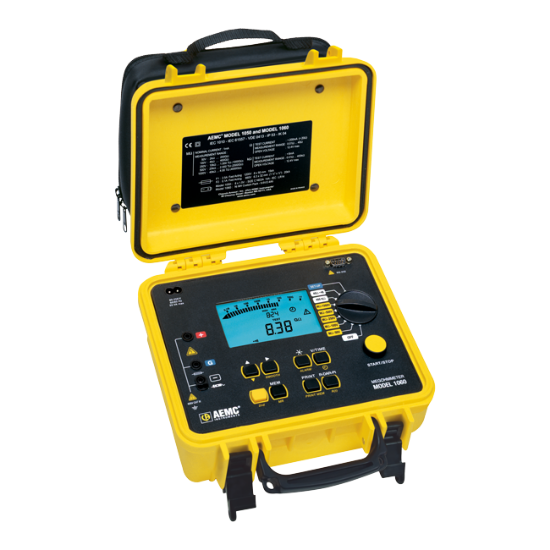 The 1060 megohmmeter: 50–1000 V test voltages with automatic DAR/PI ratios.
Insulation resistance. A multimeter’s ohms function pushes ~3 V through insulation and calls anything above 20 MΩ open — so failing insulation looks healthy. The Model 1060 Megohmmeter ($2,750) applies 50–1000 V DC, reads into the gigohms, and — the part that separates a real IR test from a number on a screen — automatically computes DAR and PI ratios, the time-based indices that distinguish “dry, healthy insulation” from “wet winding that reads fine for the first ten seconds.” With 128 kB of memory and DataView export, it produces the trend documentation a 70B maintenance program actually requires: insulation condition is a trajectory, not a snapshot.
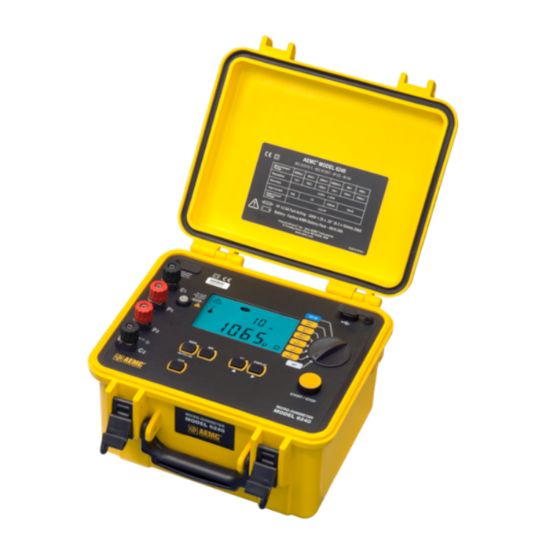 The 6240 resolves micro-ohms — where loose and corroded connections hide from every multimeter.
Connection resistance. The Model 6240 Micro-Ohmmeter ($3,720) works the opposite end of the resistance scale: micro-ohms, measured by driving up to 10 A of test current through breaker contacts, bus joints, weld bonds and motor windings. A corroded lug that reads 0.0 Ω on a multimeter reads, say, 800 µΩ against a 150 µΩ sister connection here — and resistive connections are among the most common origins of electrical fires and thermal-camera hotspots. This is the instrument that confirms what the infrared survey suspects.
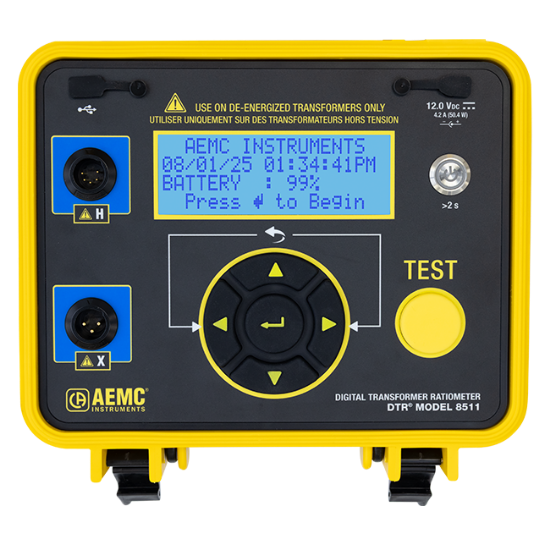 The 8511 DTR: automatic turns ratio, excitation current and polarity for transformer condition testing.
Transformer integrity. The Model 8511 Digital Transformer Turns Ratiometer ($3,790) measures a transformer’s actual turns ratio, excitation current and polarity, fully automatically. Shorted turns — the classic slow transformer death — shift the ratio away from nameplate long before the unit fails outright. For any facility with owned distribution transformers, a periodic DTR test is how you find out on your schedule instead of the transformer’s.
The full lineup, and where to start
Two instruments don’t fit the four-job frame but round out the catalog: the Model 1110 Lightmeter Data Logger ($560), which logs illuminance over time — the before/after evidence for lighting retrofits and an underrated occupancy proxy — and the everyday meters above, which end up in every toolbag regardless.
The complete AEMC list at Aim Dynamics, as of July 2026:
| Instrument | Price | One-line verdict |
|---|---|---|
| 6611 Phase & Motor Rotation Meter | $109 | Buy first. Cheapest damage-prevention per dollar here. |
| 5233 Digital Multimeter | $125 | The TRMS everyday meter. |
| 514 Clamp-on Meter | $230 | The everyday load-check clamp. |
| MA193-10-BK MiniFlex Sensor | $290 | Default PEL sensor for tight panels. |
| 193-24-BK AmpFlex Sensor 24” | $335 | For bus bars and paralleled runs. |
| 275HVD High Voltage Detector | $349 | The “is it actually dead?” check to 275 kV. |
| MN193-BK AC Current Probe | $353 | Small-load logging down to milliamps. |
| Power-to-Phase Adapter | $399 | Powers the PEL from the measured phases. |
| 404 Clamp-on Meter | $489 | The DC-heavy clamp for solar/battery buses. |
| 1110 Lightmeter Data Logger | $560 | Lighting retrofit M&V evidence. |
| 1060 Megohmmeter | $2,750 | The insulation trend-keeper (DAR/PI, memory, export). |
| PEL 113 Power & Energy Logger | $2,990 | The workhorse. If you buy one big item, it’s this. |
| 6240 Micro-Ohmmeter | $3,720 | Confirms what the thermal camera suspects. |
| 8511 Digital Transformer Turns Ratiometer | $3,790 | Finds dying transformers on your schedule. |
If you’re building from zero on a facilities budget, the sequence that matches how problems actually arrive: 6611 + 5233 + 514 (under $500, covers verify and measure), then the PEL 113 kit when you’re ready to argue with your utility bill from data, then the 1060 megohmmeter as the first NFPA 70B condition-testing purchase. The 6240 and 8511 earn their keep once you own enough switchgear and transformers that a single prevented failure pays for the instrument — which, at commercial downtime rates, is usually one failure.
Field note
Two items from this list have earned their place in my kit by use, not theory. The PEL 113 is one I’ve actually used in the field: it goes into the panel, the flexible sensors wrap around conductors a rigid clamp would never fit, and it comes back with a load profile that settles arguments no spot reading ever could. The other is the clamp meter, which simply never leaves the bag — most site questions start with “how much is this circuit actually carrying?” and end about thirty seconds after you clamp it. The rest of the lineup I’d buy in the order the article suggests; those two I can vouch for from the field.
Sources
- AEMC Instruments — Power & Energy Logger Model PEL 113 — manufacturer specifications
- AEMC Instruments — manufacturer datasheets for the 1060, 6240, 8511, 275HVD, 6611 and clamp/multimeter lines
- NFPA 70B, Standard for Electrical Equipment Maintenance (2023) — the recommended-practice-to-standard change
- ESFI — NFPA 70B: What the Change Means for Maintenance, Operations and Safety
- EC&M — Understanding Insulation Resistance Testing — test voltages, DAR/PI methodology
- Aim Dynamics — AEMC Instruments catalog — pricing as of July 2026