The phrase data acquisition system gets used constantly in our industry, and almost never with a shared definition. Ask a solar developer, a property manager, a plant engineer and an AI team what a DAS is, and you’ll get four confident, completely different answers — each correct in its own context, none of them the whole picture. Strip away the jargon and a data acquisition system is one thing: the bridge between what is physically happening in a building and what you can actually measure, analyse and act on. Every DAS, whatever the brand or vertical, does four jobs — it senses, collects, stores, and presents. Without that chain, a building is a black box and you are optimising on guesswork.
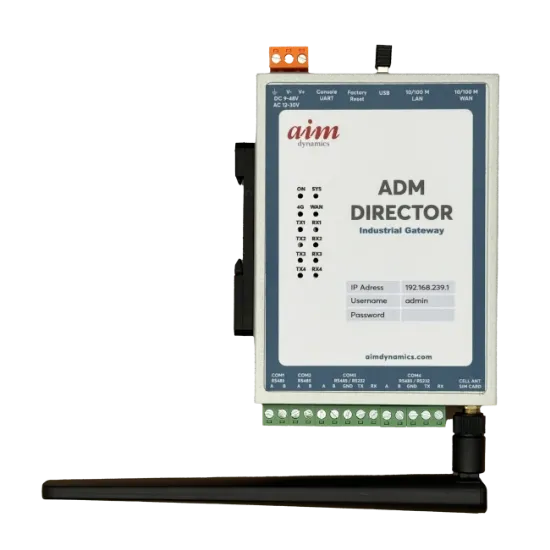 A DAS in hardware form: the ADM Director gateway senses through Modbus/eGauge/MQTT meters, collects and stores locally, and serves one on-premises portal.
The four jobs every DAS does
Forget the marketing categories for a moment. Whether it’s a solar string logger, a plant SCADA system, a building management system, or an energy monitoring portal, every data acquisition system is a version of the same four steps:
- Sense. Sensors read real-world variables — voltage, current, temperature, flow, pressure. In power monitoring, this is the meter and its current transformers.
- Collect. Hardware gathers and processes those raw signals, often across several incompatible protocols, into a single coherent feed.
- Store. The history is kept — locally, in the cloud, or both — so you can look back as well as look now.
- Present. Software organises and displays the data, and connectivity lets you reach it from wherever you happen to be.
Miss any one of the four and the system stops being useful. Sensing without storage gives you a number that vanishes. Storage without presentation gives you a database nobody opens. The art is making all four reliable at once, on a real site, with the meters that are actually installed.
Why “DAS” means something different in every building
The reason the term is so slippery is that each discipline lives in a different slice of those four steps:
- A solar developer means inverter- and string-level logging — production data to prove a system is performing.
- A property manager means tenant submetering and billing — who used what, and who pays.
- A plant engineer means SCADA and process control — keeping a line running safely in real time.
- An AI team means the clean, timestamped data feed their models train and run on.
All four are right. The common thread — the one I’ve seen hold true across hundreds of energy audits in Kenya, Tanzania, Uganda, Guatemala and now Colorado — is that the building has activity nobody can see, and the job is to make it visible. The label on the box matters far less than whether the sense-collect-store-present chain is trustworthy end to end.
Where the ADM Director fits
Most real sites are not one clean system — they’re a pile of meters that refuse to talk to each other. Five eGauges each with their own login. An Elkor multi-circuit meter next to a couple of ADM three-phase meters and a handful of generic Modbus devices, all speaking different dialects. The meters work; the data is scattered.
The ADM Director is what a DAS looks like when you build it for that reality. It’s a self-hosted data acquisition and visualization platform that does all four jobs in one box:
- Senses through any Modbus RTU/TCP, MQTT or eGauge meter — a universal translator for mixed-protocol sites.
- Collects those feeds into one coherent stream, on-premises.
- Stores up to 30 years of history locally, inside your own network.
- Presents a single browser-based portal — charts, outside-temperature overlay, submetering and tenant billing, CSV/Excel export — with no monthly cloud fees.
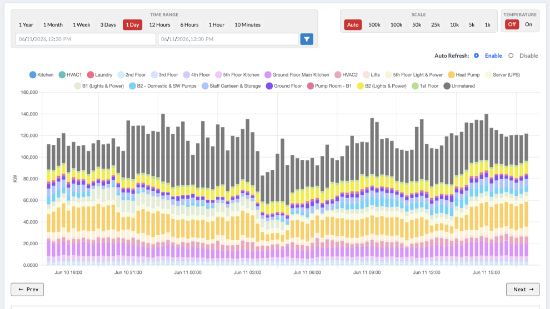 The “present” step done well: one portal for every meter, instead of five logins and a spreadsheet.
That last point is the one facility managers feel most: a DAS shouldn’t force you to rent your own data back month after month. (For the full hardware story, configurations and order codes, see the commercial energy monitoring system deep-dive.)
What AI actually adds to a DAS
Here’s the part the hype gets backwards. AI does not replace the data acquisition system — AI is the layer you build on top of it. Once the sense-collect-store-present chain is producing clean, continuous, timestamped data, machine learning can finally do useful work:
- Anomaly detection — flagging the overnight load that shouldn’t be there, the set-point that drifted, the dawn-of-shift spike.
- Phantom-load hunting — surfacing the 5–12% of “invisible” consumption most sites carry without knowing it.
- Demand forecasting — predicting peaks before they cost you on a demand charge or a BPS penalty.
- Closed-loop and agentic control — the early-2026 frontier, where models don’t just report but nudge equipment.
But every one of those inherits the quality of the data beneath it. A gap in collection, a clock drift in storage, a mislabeled circuit at the sensing layer — and the model confidently produces a wrong answer. No DAS, no AI. This is exactly why our Eagles analytics and the ADM Director portal are two halves of one idea: the DAS earns the data, and AI turns it into a decision. Skip the foundation and you’ve automated guesswork.
From data to decision — the whole point
Collecting data is only half the job. The other half is turning it into an action without getting bled dry by recurring fees or buried in dashboards nobody trusts by Friday. A good data acquisition system makes the invisible visible; a good AI layer makes the visible decidable. Get the four jobs right — sense, collect, store, present — keep the data on-premises and yours, and the analytics on top stop being a science project and start paying for themselves.
Field note
The honest version: nobody I walk a mechanical room with asks “what is your data acquisition system?” They ask “why is my bill like this?” — and the answer is always buried in a panel nobody is metering. Fifteen years in, the pattern hasn’t changed, only the tooling has. The clients who relax aren’t the ones who bought the fanciest meters or the shiniest AI; they’re the ones who stopped logging into five dashboards to answer one question. AI is genuinely changing how we audit and operate buildings in 2026, but it has made the boring part more important, not less: the model is only ever as good as the sense-collect-store-present chain underneath it. Fix the DAS first. Then let the AI earn its keep.
Sources
- ADM Director — self-hosted data acquisition and visualization platform (Aim Dynamics) — product page, specifications, configurations, and order codes.
- eGauge Systems — eGauge energy meters and dataloggers reference.
- Elkor Technologies — MCM multi-circuit meter — high-channel-count metering reference.
- Modbus Organization — Modbus RTU / TCP protocol reference.
- Eagles Energy Management Portal (Eenovators) — AI analytics and machine-learning energy reports built on metered data.
Ready to make your building visible?
See the full technical datasheet, explore every supported integration, and pick the right configuration for your site:
→ Get the Datasheet & Explore the ADM Director
Self-hosted. No monthly cloud fees. Every meter, one portal — the foundation your AI layer deserves.