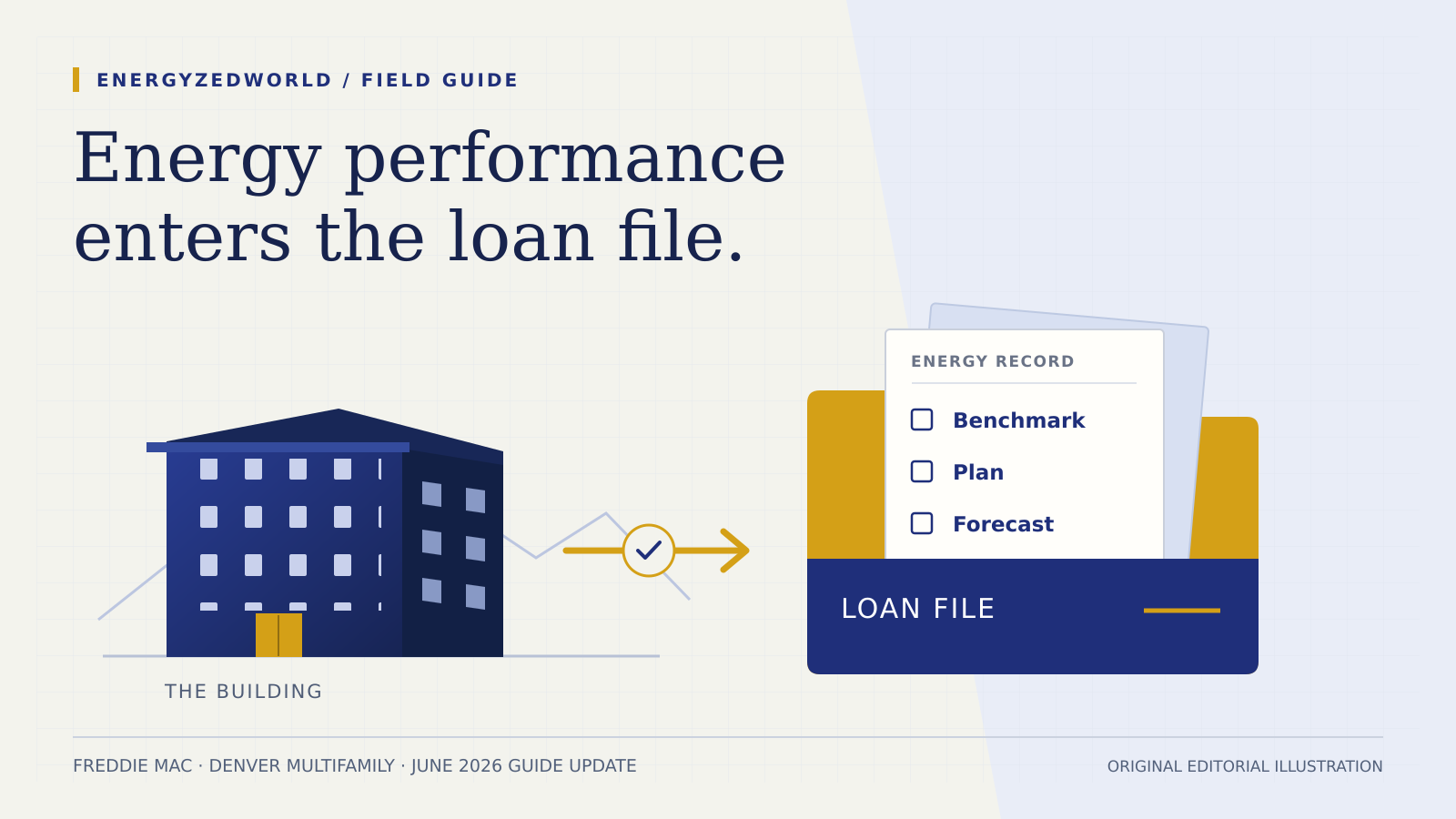
If you own or manage a multifamily building in Denver, there’s a new reason to care about Energize Denver. It is showing up in Freddie Mac loan underwriting. For a Denver apartment building financed or refinanced through Freddie Mac, your lender now needs documentation of the building’s compliance position and, where required, a plan for addressing it.
I talk with owners and property managers every week, and this one is catching a lot of people off guard. So here’s a plain-English rundown of what changed and what you can do about it.
What Freddie Mac changed
On June 23, 2026, Freddie Mac issued Guide Bulletin M2026-3. Effective immediately, it updated Chapter 55 of the Multifamily Seller/Servicer Guide to require Energize Denver documentation for properties in the City and County of Denver. The current Chapter 55, dated August 25, retains the requirements. June 23 bulletin · Chapter 55, pp. 14–15
What your lender asks for depends on your building’s size.
If your building is 25,000 sq ft or larger
Expect to provide:
- Accepted benchmarking status from the Energize Denver Management Portal. A submission alone is not the same as an accepted report.
- A retrofit plan with estimated improvement costs, a timeline and projected energy reduction.
- The borrower’s business plan and intentions related to Energize Denver.
- A screenshot of the Energize Denver Forecasting Calculator identifying the property, its most recent Energy Use Intensity (EUI), and all forecasted fines at current EUI levels.
That last one is worth pausing on. Your lender will see the calculator’s forecast of fines if the building continues at its current EUI. A forecast is a planning scenario; it is not a fine already assessed. Chapter 55, pp. 14–15
If your building is 5,000–24,999 sq ft
The bar is lighter, but it’s still there. Provide proof of compliance from the Energize Denver Building Look Up Tool. If the building is compliant, no further documentation is required under this provision.
If it is not compliant, provide the borrower’s business plan and intentions related to Energize Denver, plus a retrofit plan with estimated improvement costs and a timeline. Projected energy reduction is expressly listed for the larger-building tier, rather than this smaller-building documentation list. Chapter 55, p. 15
Why being “off track” belongs in the financing discussion
The practical issue is timing. If you wait until loan underwriting to gather the records, you may also be trying to resolve data problems, scope improvements and find a budget while the transaction is moving toward closing.
Ask your lender whether compliance gaps affect reserves, escrow or other loan conditions; requirements are transaction-specific. Buyers should request Energize Denver records from sellers early in due diligence, so the financing team has time to review the building’s position.
This is where an appropriately scoped energy-efficiency study earns its place. A useful study connects the energy baseline to practical measures, estimated costs, implementation timing and expected savings. It gives the owner and lender a plan they can discuss.
The cited Freddie Mac provision does not impose a blanket requirement for a named ASHRAE audit level. The commercial reason to do the study is to make the retrofit plan credible. Agree on the scope with your engineer and lender, including any separate requirements of a rebate or compliance pathway.
“But isn’t there a lawsuit?”
Yes. On September 30, 2026, U.S. District Judge Regina Rodriguez allowed the building-wide preemption challenge to continue. The court also dismissed the consumer-appliance claims as untimely; claims concerning commercial covered products remained. This was a motion-to-dismiss ruling, not a decision striking down the building-performance laws. September 30 order, especially pp. 8–13 and the conclusion
Here’s the part that matters for planning: that order did not stay enforcement. It gives an owner no basis to treat the case as a compliance extension. Keep preparing the documents your lender needs, and check with counsel and the city for any later orders before relying on a change in enforcement.
Don’t forget the state deadline
Denver’s program has separate requirements for covered buildings of 5,000–24,999 sq ft and 25,000 sq ft or more. Separately, Colorado’s statewide Building Performance Colorado program generally covers buildings of 50,000 sq ft or more, subject to statutory exclusions and exemptions. Do not use one program’s threshold to decide coverage under the other.
For covered state buildings, the annual reporting window closes November 1, 2026. Check the benchmarking report, applicable fees and the BPC Progress Survey required beginning in 2026. The annual fees are generally $400 for the Building Decarbonization Enterprise plus $100 for benchmarking, usually $500 total for a nonexempt building. Fee exemptions apply, including for qualifying public buildings. State roadmap to compliance · State annual-fee guidance
As of this article’s publication on October 12, that deadline is less than three weeks away. Colorado HB 25-1269 sets the annual November 1 benchmarking deadline beginning in 2026; the state obligation remains separate from Denver reporting.
A quick checklist before your next loan
- Know your square footage and applicable tier. Confirm the building and property details with your lender.
- Verify the official record. For 25,000+ sq ft, check accepted benchmarking status in the Management Portal. For the smaller tier, check compliance in the Building Look Up Tool.
- Prepare the forecast where required. For the larger tier, capture the property, latest EUI and all forecasted fines at current EUI levels in the calculator screenshot.
- Put a realistic retrofit plan on paper. Include costs and timing, plus projected energy reduction for the larger tier. For a compliant smaller building, the Guide says the compliance evidence is sufficient.
- Write down the business plan and intentions where required. Explain how the owner intends to address the building’s position.
- Check the separate state obligations. If your building is covered, calendar November 1 and confirm reporting, survey and fee requirements and exemptions.
- Talk to your lender early. Agree on the documents and any transaction-specific loan conditions before closing becomes urgent.
Field note: turn the paperwork into a practical plan
Energize Denver can feel like something to deal with “later.” The Freddie Mac update makes that harder to do when a loan or refinance is approaching.
The useful work is straightforward: a clear picture of your energy use, an accurate compliance record and a realistic plan. That same foundation can help identify operating-cost savings and manage compliance risk. The outcome still depends on the building, the measures selected and how well they are implemented.
If you’d like a hand with benchmarking or an efficiency study for your building, I’m always happy to help. You can explore Aim Dynamics’ energy services to get started.
Chris Mbori, Business Development and Energy Engineer, Aim Dynamics
EnergyzedWorld is my independent personal blog. This article is practical commentary, not legal advice or a guarantee of compliance, savings or financing approval. Requirements discussed here were checked as of October 12, 2026.
Sources
- Freddie Mac, Guide Bulletin M2026-3, June 23, 2026.
- Freddie Mac Multifamily Seller/Servicer Guide, Chapter 55, August 25, 2026, pp. 14–15.
- Energize Denver official resources, including the Management Portal, building lookups and Forecasting Calculator.
- U.S. District Court for the District of Colorado, September 30, 2026 order in Colorado Apartment Association et al. v. Ryan et al..
- Colorado HB 25-1269, signed law.
- Building Performance Colorado, Roadmap to Compliance.
- Building Performance Colorado, Annual Fees.