Every week, homeowners and businesses reach out asking for an off-grid solar system. They want to cut ties with KPLC completely, never pay another electricity bill, and have total control over their power supply. The intention is completely understandable. After years of rising bills, unexplained charges, and outages that seem to happen at the worst possible moments, wanting out of that relationship makes perfect sense.
But here is something most solar installers won’t tell you upfront: for the majority of Kenyan homeowners and businesses that are already connected to the grid, a full off-grid system is not the most practical or cost-effective solution. For others — particularly those in remote locations, on farms, or in areas where the grid simply does not reach — off-grid solar is not just a good option, it is the only viable one.
Before investing millions of shillings in a fully off-grid system, it is worth understanding the economics behind solar energy independence.
The system that delivers maximum independence is rarely the system that delivers the best financial return. The gap between the two is the last 20%.
The single chart that explains everything
If you remember one thing from this article, make it this curve. Cost does not rise in a straight line as you chase energy independence — it bends upward steeply near the end. Going from 0% to 80% solar coverage is relatively cheap per percentage point. Going from 80% to 100% is where the money disappears.
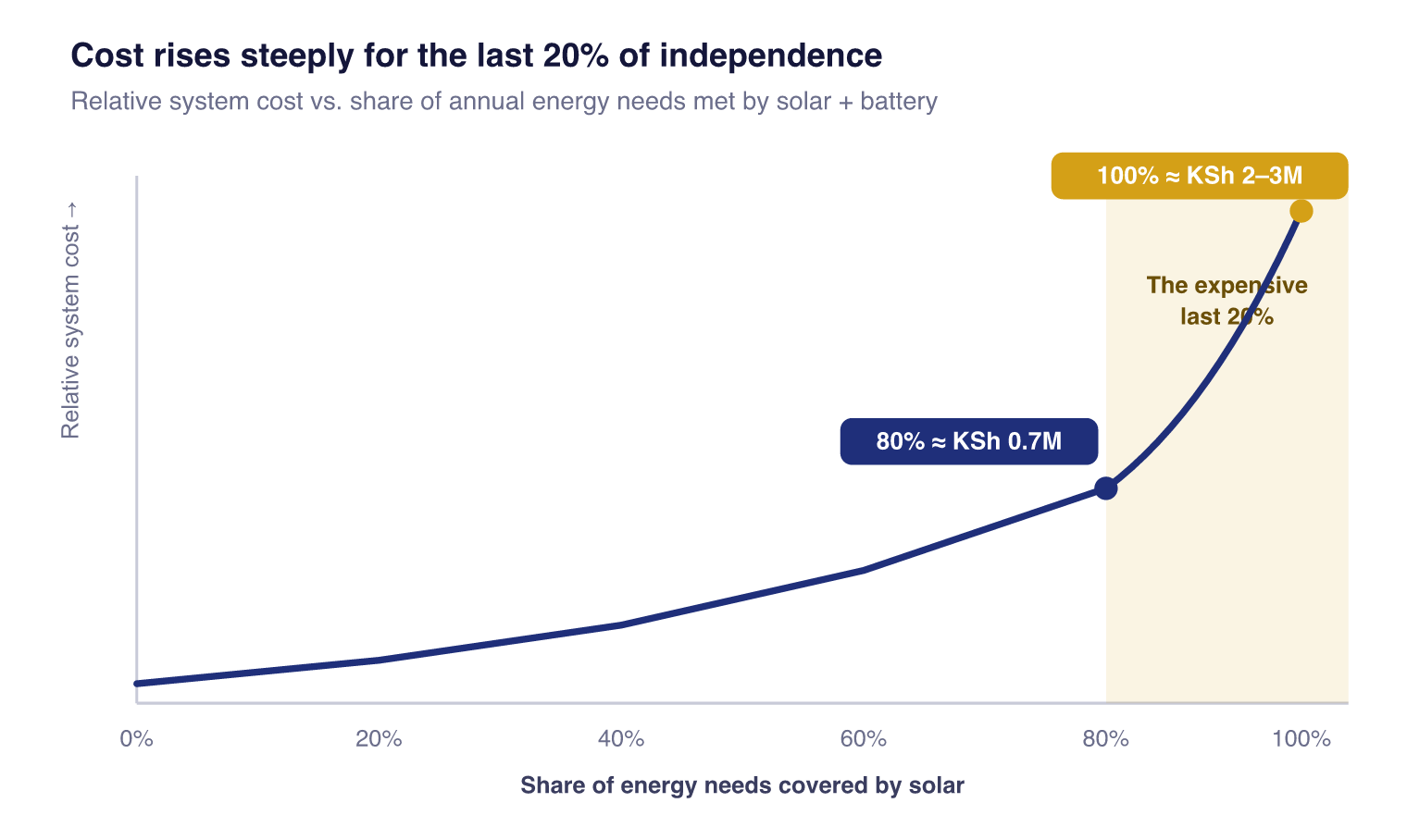
Illustrative cost curve for a typical ~10 kWh/day Kenyan home. The first 80% of independence is affordable; the final 20% multiplies the price.
Key Takeaways
- The final 10–20% of energy independence is often the most expensive part of a solar system.
- Most homeowners achieve better returns with systems covering 80–90% of their annual energy needs.
- Fully off-grid systems require significantly larger battery banks and solar arrays.
- High-power appliances can dramatically increase off-grid system costs.
- Hybrid solar systems often deliver the best balance of savings, reliability, and return on investment.
Also read: Hybrid Solar (and Wind): the answer to the power-availability question
What Is an Off-Grid Solar System?
An off-grid solar system operates completely independently from the electricity grid. Instead of relying on KPLC, the property generates and stores all of its electricity using solar panels, batteries, and inverters. This means the system must be capable of meeting energy demand not only during sunny days but also during cloudy weather, rainy periods, and times of unusually high consumption.
This is fundamentally different from a hybrid solar system, which uses solar and battery as the primary sources but retains the grid as a quiet automatic backup. In a hybrid system, the grid fills in the small gaps — typically the overcast days when solar can’t fully charge the battery and the battery cannot fully cover the load. In an off-grid system, there is no grid to fall back on. The solar array and battery bank have to handle everything, every day, including the worst weather days of the year.
That requirement — designing for worst-case conditions rather than average conditions — is what drives the cost of off-grid systems so significantly higher than hybrid alternatives.
Thinking about going solar? Eenovators Limited offers a free consultation, site assessment, and no-obligation quotation. Email [email protected] or use the contact form on eenovators.com. Start your journey today.
Why So Many Homeowners Want to Go Off-Grid
The desire for energy independence is understandable. Many homeowners are frustrated by:
- Rising electricity bills
- Fuel cost adjustments
- Foreign exchange adjustments
- Unexpected tariff changes
- Frequent outages
- Dependence on KPLC
For some people, going off-grid represents freedom from all these challenges. Others are motivated by environmental concerns and want to maximize their use of renewable energy.
These goals are completely valid. However, there is an important distinction between energy independence and financial optimization. The solar system that delivers maximum independence is not always the system that delivers the best financial return. That distinction becomes particularly important when discussing the final 10–20% of energy demand.
Why the Last 10–20% of Energy Independence Is the Most Expensive
Many homeowners assume that if a system covering 80% of their energy needs costs KSh 700,000, then achieving 100% independence might cost around KSh 850,000.
Unfortunately, that is not how solar design works. The closer you get to complete independence from the grid, the more rapidly costs increase. Consider a household consuming approximately 10 kWh per day.
| Variable | 80–90% Hybrid System | 100% Off-Grid System |
|---|---|---|
| Daily energy demand | 10 kWh | 10 kWh |
| Solar array | 3–4 kWp | 8–12 kWp |
| Battery storage | 10 kWh | 25–40 kWh |
| Inverter | 5 kW | 8–12 kW |
| Grid connection | Yes | No |
| Typical installed cost | KSh 500,000–800,000 | KSh 2,000,000–3,000,000 |
| Payback period | 4–6 years | 15–25 years |
Notice what the table shows clearly. Getting from 80% solar coverage to 100% costs two to four times more money. That additional investment buys you the ability to cover the remaining 20% of your annual consumption without grid input.
For a home already connected to KPLC, the grid covers that 20% at a cost of roughly KSh 1,000 to KSh 2,000 per month. Paying KSh 1.5 million extra upfront to avoid that monthly cost has a payback period longer than many solar system components last.
Why Solar Systems Must Be Designed for Bad Weather Days
When homeowners think about solar, they often imagine bright sunny days. Solar designers think about cloudy days. A system that performs perfectly during ideal conditions can still struggle during periods of poor weather. This is particularly important when designing off-grid systems.
A household may comfortably meet its daily energy needs with a 4 kWp solar array during a typical sunny week. But what happens during several consecutive cloudy days? Solar production can drop significantly. If the home remains connected to the grid, KPLC automatically supplies the difference and the homeowner may barely notice.
If the property is fully off-grid, there is no backup source. The only solution is to install more solar panels, more batteries, and larger inverter capacity. The challenge is that this additional equipment may only be required for a few weeks each year. For the remaining months, much of that capacity sits underutilized — yet the homeowner must still pay for it upfront. This is one of the primary reasons fully off-grid systems become so expensive compared to hybrid alternatives.
The Hidden Cost of Battery Storage
When homeowners compare hybrid and off-grid solar systems, the conversation often focuses on solar panels. In reality, batteries are usually the biggest reason fully off-grid systems become expensive.
A battery’s job is simple: it stores excess solar energy during the day and supplies that energy when the sun is not available. The challenge is that an off-grid home depends entirely on battery storage every night and during periods of poor weather. That requires significantly larger battery banks than a typical hybrid system.
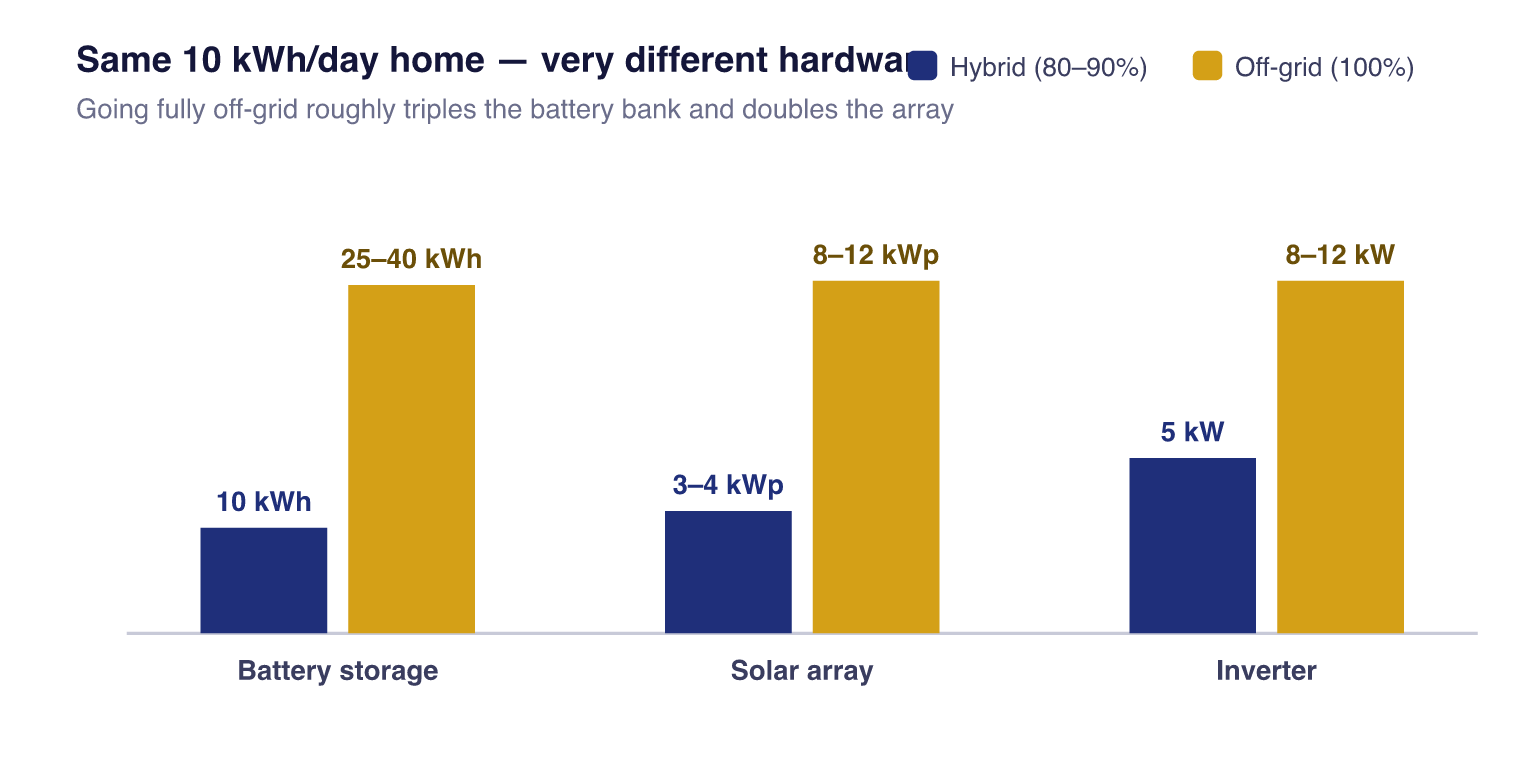
For an identical daily load, the off-grid version needs roughly 3× the battery, ~2.5× the array and ~2× the inverter — and you pay for all of it upfront.
For example, a household using 10 kWh per day may operate comfortably with a 10 kWh battery in a hybrid setup because KPLC remains available as a backup source. An off-grid version of the same home may require 25–40 kWh of battery storage to provide enough reserve capacity for cloudy days and unexpected consumption. This dramatically increases project costs.
Battery replacement must also be considered. While modern lithium batteries can last 10–15 years or longer, they do not last forever. The larger the battery bank, the greater the future replacement cost. This is why many homeowners are surprised to discover that achieving complete energy independence is often more about buying batteries than buying solar panels.
Why High-Power Appliances Make Off-Grid Systems Expensive
Most household appliances are very solar-friendly and can be powered efficiently by a properly designed solar system. These include lighting, refrigerators, freezers, televisions, Wi-Fi equipment, laptops and computers, washing machines, water pumps, and general power outlets.
The challenge comes from appliances that generate heat. Heating appliances consume large amounts of power over short periods and place significant demands on batteries and inverters.

A single instant shower can draw more power than your entire evening of lighting, TV and phone charging combined.
Common examples include:
Instant Electric Showers
An instant shower draws between 3,000 and 6,000 watts — and some high-powered models push up to 7,000 watts — every time it runs. In some homes, a single shower session consuming 1.5 to 2.5 kWh can use more power than an entire evening of lighting, television, and phone charging combined.
Electric Water Heaters
A storage geyser draws between 1,000 and 3,000 watts and cycles on repeatedly throughout the day to maintain water temperature, consuming anywhere from 3 to 6 kWh daily even when nobody is actively using hot water. Supporting it entirely through solar often requires larger batteries and more solar generation capacity.
Electric Ovens
A standard electric oven draws between 2,000 and 5,000 watts continuously while cooking, and a single meal preparation session can consume 1 to 2 kWh before the food is on the table. While they may not run all day, their short-term demand significantly impacts system sizing.
Room Heaters and Electric Fireplaces
These appliances draw between 1,000 and 2,500 watts and, because they are often left running for hours at a stretch, can easily consume 3 to 5 kWh in a single evening. They convert electricity directly into heat and are among the least solar-friendly loads you can include in a system.
Induction Cookers
A standard induction cooker draws between 1,000 and 2,000 watts per plate, and a household running two plates simultaneously for an hour consumes 2 to 4 kWh in a single cooking session. Electric cooking appliances can dramatically increase both battery and inverter requirements.
For homes with access to KPLC, it is often more economical to leave these loads on the grid while allowing solar to power the majority of daily consumption. This approach captures most of the savings without forcing the homeowner to invest in an unnecessarily large system.
When Does an Off-Grid Solar System Actually Make Sense?
At this point it is important to clarify that off-grid solar systems are not a bad idea. In fact, there are many situations where they are the best solution available.
- Remote homes: For properties located far from existing power lines, obtaining a KPLC connection can be extremely expensive. In some cases, the cost of grid extension exceeds the cost of a solar system.
- Farms and ranches: Agricultural properties often operate in areas with limited grid infrastructure. Solar provides a reliable and predictable energy source for pumps, homes, security systems, and agricultural equipment.
- Lodges and camps: Tourism facilities located in remote areas frequently rely on solar because extending grid infrastructure is impractical.
- Areas with poor grid reliability: Some regions experience frequent and prolonged outages. Where reliability becomes a serious challenge, complete energy independence may justify the additional investment.
In these cases, an off-grid system can still be the right decision — if expectations and costs are fully understood. The key point is that off-grid systems make the most sense when there is a genuine need for independence, not simply because eliminating the electricity bill sounds appealing.
Also read: How much does a residential solar PV installation cost?
Why Hybrid Solar Systems Are Usually the Better Choice
For most homes connected to KPLC, hybrid solar systems offer the best balance between savings and practicality. A hybrid system combines solar panels, battery storage, and a grid connection.
During the day, solar panels power household loads directly. Any excess energy charges the batteries. In the evening, the batteries continue supplying power. Only when solar and battery energy are insufficient does the system draw power from KPLC.
| Advantage | What it means for you |
|---|---|
| Lower initial investment | Fewer solar panels and smaller battery banks keep installation costs manageable. |
| Faster payback period | Lower investment means you recover costs in 4–6 years, versus 15–25 years for off-grid. |
| Reliable backup power | Unlike traditional grid-tied systems, hybrid systems keep running during outages. |
| Smaller battery requirements | The grid acts as a safety net, removing the need for a massive battery bank. |
For many homeowners, the result is a system that delivers most of the benefits of energy independence without the excessive cost of pursuing complete independence.
Get Expert Solar Advice Before Going Off-Grid
A fully off-grid solar system can be an excellent solution in the right circumstances. For remote properties, farms, lodges, and locations with limited grid access, complete energy independence often makes perfect sense. However, for many homes that already have a reliable KPLC connection, pursuing 100% off-grid operation can result in significantly higher costs without delivering proportional financial benefits.
Eenovators Limited helps homeowners identify the most practical and cost-effective solar solution based on their actual energy usage, budget, and long-term goals. Whether you are considering a hybrid or off-grid system, our team can help you make an informed decision that delivers real value for years to come.
Talk to us before you buy:
- Email: [email protected]
- Contact form: eenovators.com/contact
- What you get: a free consultation, site assessment, and a no-obligation quotation.
Field note
The homeowners who regret their solar spend are almost never the ones who under-bought — they are the ones who paid for the last 20% they never needed. We have walked into homes with 40 kWh of batteries sitting at 90% charge for eleven months of the year, bought to survive a cloudy week that a KSh 1,500 KPLC top-up would have covered. The discipline that saves money is boring: meter your real consumption first, decide which heat-producing loads genuinely have to run off solar, and let the grid quietly cover the expensive tail. Independence feels good. A four-year payback feels better — and on most grid-connected Kenyan homes, you only get one of those two by giving up a sliver of the other. Size for the bill you actually pay, not for the bill you are angry about.