Energy stopped being a utility line. It became a financial decision.
Every few years a report comes along that doesn’t tell you something new so much as confirm something you’ve been feeling on the ground. The 2026 Energy Efficiency Investment Report is one of those. I read it the way a practitioner reads anything — looking past the headline percentages for the trend underneath them. Here is what stood out, why it matters, and the two things the report quietly leaves out.
If you want to read it yourself first, here is the full report: 2026 Energy Efficiency Investment Report →
1. Energy efficiency is no longer optional — it’s a core business priority
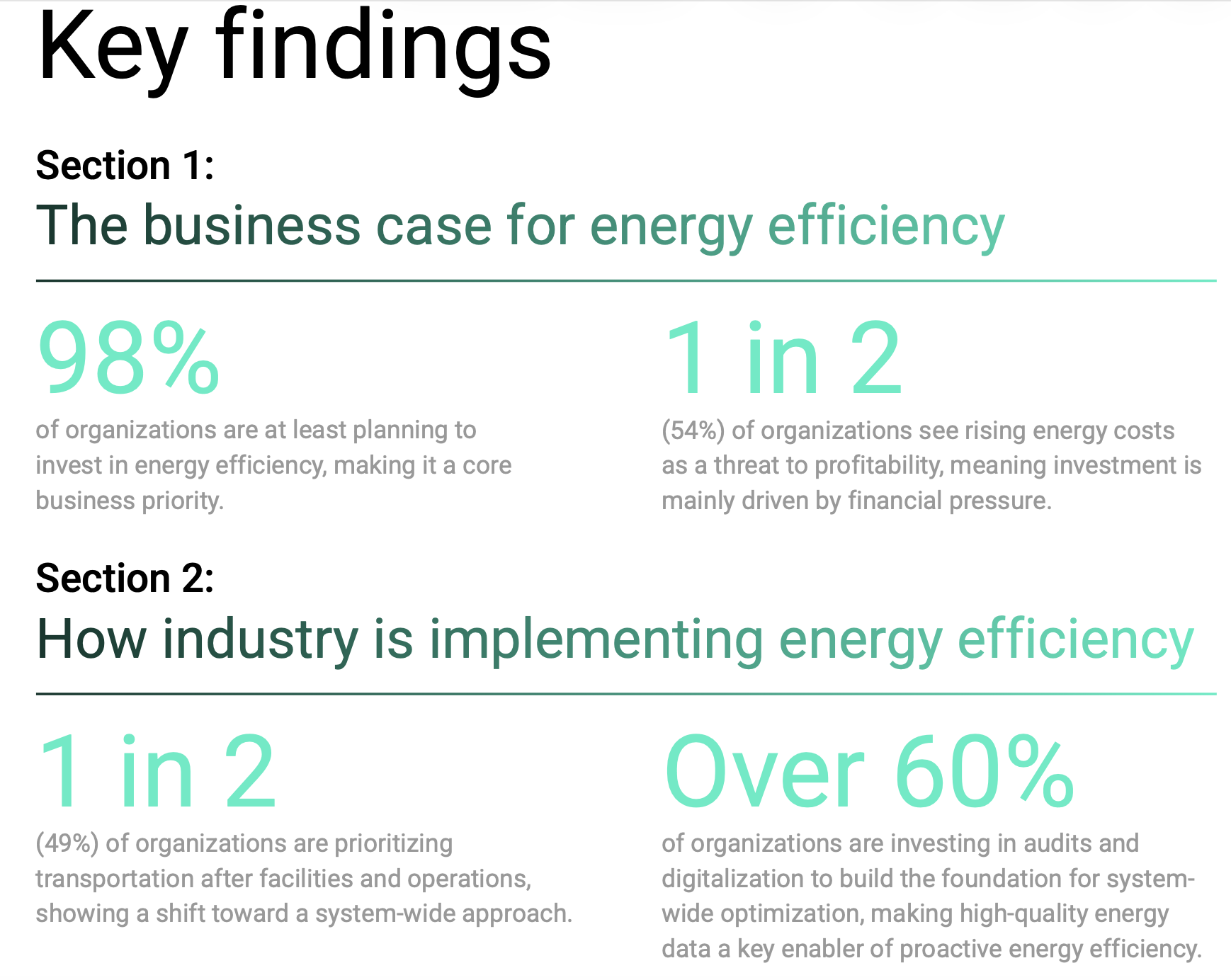 Key findings from the 2026 Energy Efficiency Investment Report.
98% of organizations are at least planning to invest in energy efficiency. Sit with that number for a second. Not “interested.” Not “considering it for the sustainability report.” Planning to invest. When 49 out of 50 organizations are moving in the same direction, efficiency has crossed over from a green initiative into a standard operating expectation — the way cybersecurity did a decade ago.
The interesting part is why. The report is clear that this isn’t being driven by idealism. More than 1 in 2 organizations (54%) now see rising energy costs as a direct threat to profitability. Investment is being pulled by financial pressure, not pushed by goodwill. That distinction changes how you should pitch, scope, and justify any efficiency project in 2026.
2. Energy is now a top-line business risk — 23% of operating costs
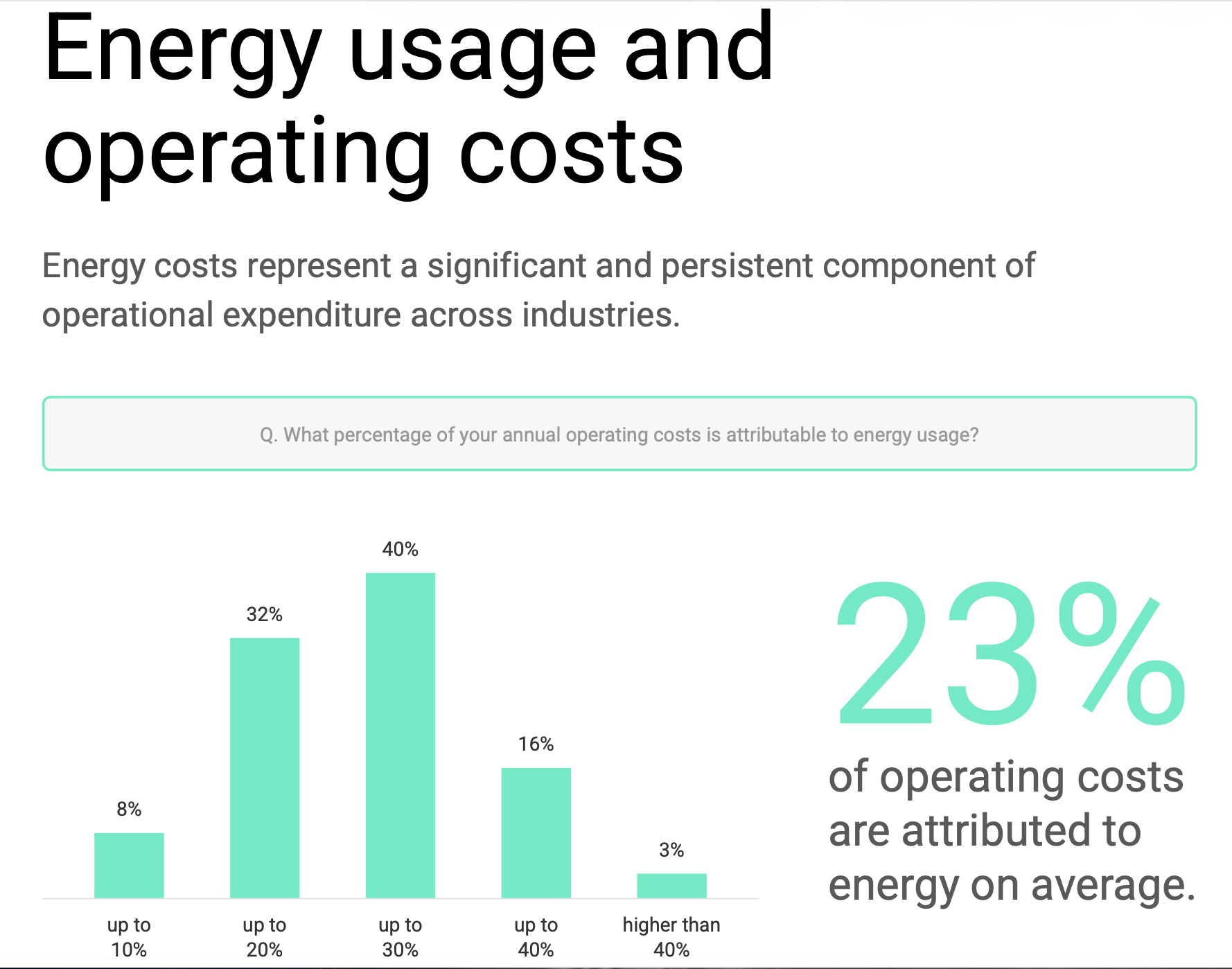 Energy as a share of operating costs — 23% on average. Source: 2026 Energy Efficiency Investment Report.
Here is the figure that reframes the whole conversation: energy accounts for 23% of operating costs on average, and significantly more in energy-intensive sectors. That is not a rounding error on a P&L. That is a quarter of your operating cost base exposed to a market you don’t control.
The report’s sharpest line follows from this: in an environment of sustained market volatility, managing energy use has become inseparable from managing financial performance. I’d go further — if you’re a CFO and you’re not looking at energy data, you have a blind spot in your cost structure the size of a building. This is also backed by recent IEA research, which found that almost 40% of industrial leaders rank energy efficiency as the single most important measure they’ve pursued to offset energy price increases.
3. The real engine underneath all of this is data
This is the part that hit closest to home for me, because it’s the work I live in. Over 60% of organizations are investing in audits and digitalization to build the foundation for system-wide optimization — and 72% are now investing in cloud and data infrastructure to monitor, manage, and optimize energy use across their operations.
High-quality energy data has quietly become the key enabler of proactive efficiency. You cannot optimize what you cannot see. As one industry voice in the report puts it: “Digitalization and electrification can cut industrial energy use by up to 30% in some applications. The key is turning data into action — seeing what’s happening in real time and automatically optimizing and controlling your systems. As complexity grows, data-led operations are how you keep efficiency scaling.”
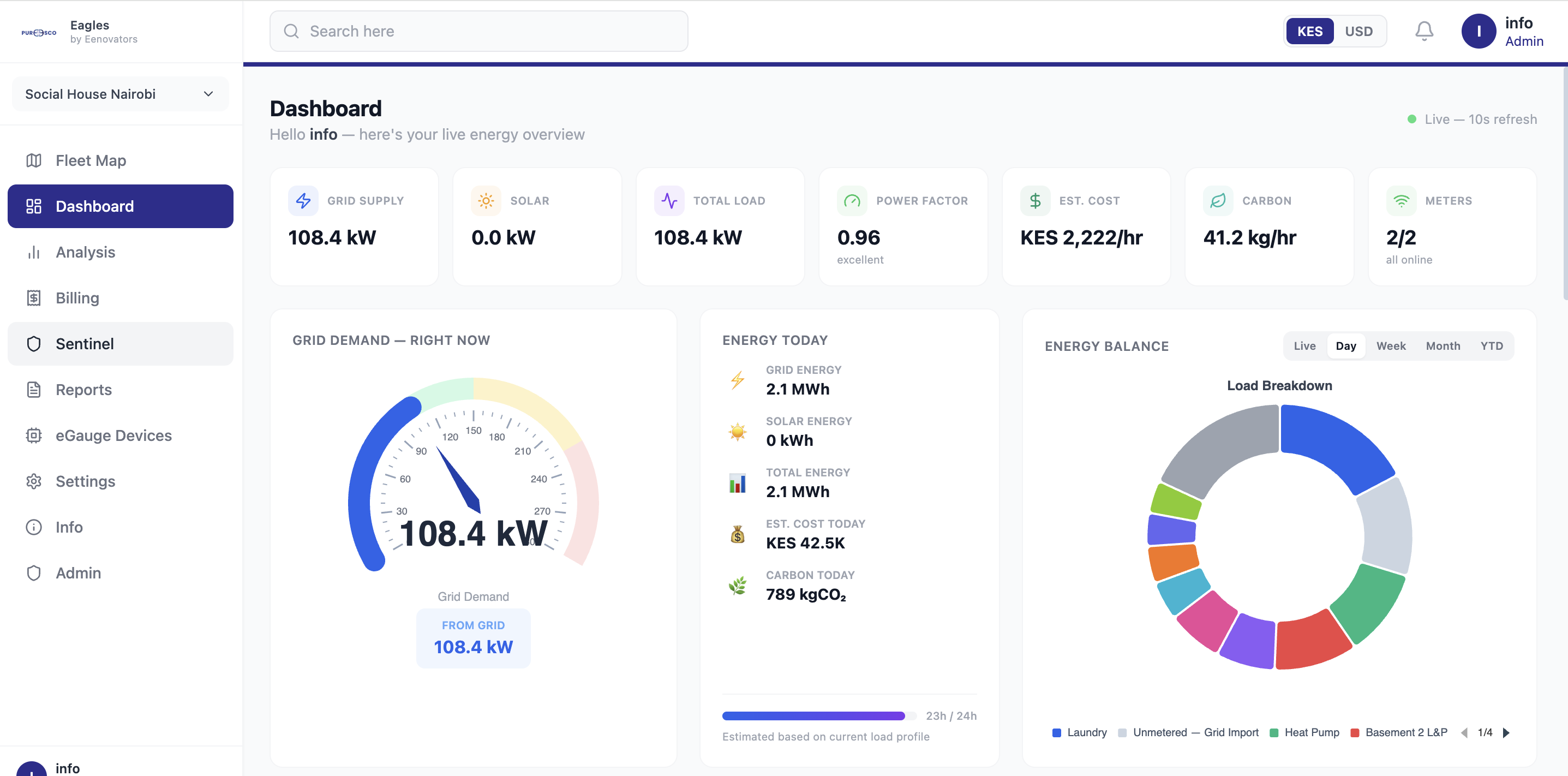
This is exactly the gap we set out to close. It’s why we built the eagles monitoring dashboard and the ADM Director industrial gateway — to take the raw signal off the meters and turn it into something a facility team can actually act on, across mixed metering ecosystems, in real time. The report didn’t tell me to build those. The report tells me the market finally understands why they exist.
4. The honest tension: ambition is real, but discipline is tighter
Now the part most write-ups skip. Despite all the momentum, progress is not keeping pace with the scale of the challenge — because investment decisions remain tightly constrained by financial discipline.
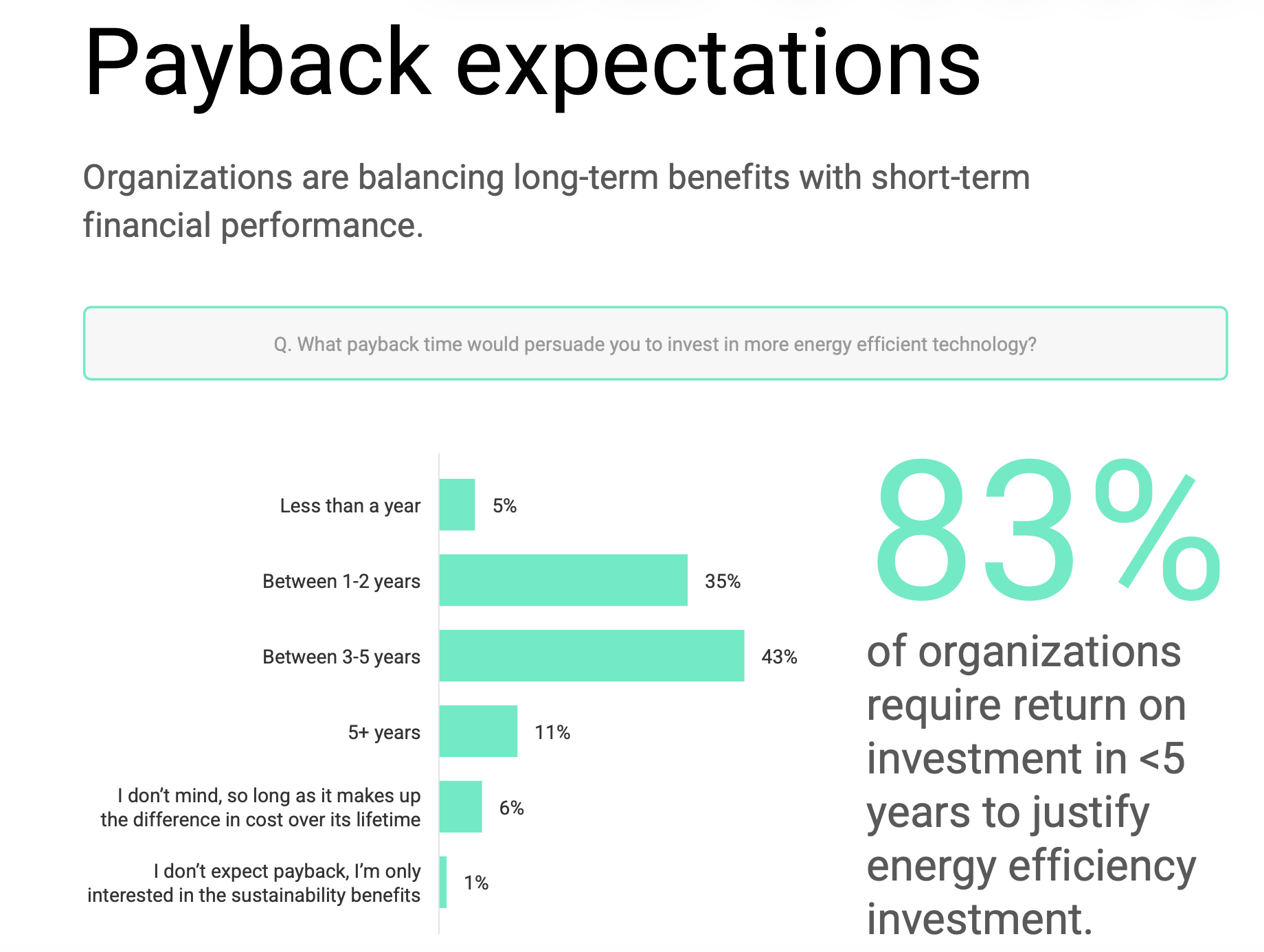 What payback would persuade organizations to invest — 83% require under five years. Source: 2026 Energy Efficiency Investment Report.
The numbers are blunt. 83% of organizations require an efficiency initiative to pay back within five years, and 40% want payback within two. Those thresholds are the real gatekeepers. They decide which projects get funded and which quietly get deferred to “next year.” If you sell, scope, or approve efficiency work, this is your operating reality: a brilliant project with a six-year payback is, for most of this market, a project that doesn’t happen.
The practitioner’s takeaway: the winning play isn’t the biggest retrofit — it’s the fastest, most measurable one. Data-led, low-capital, quick-payback measures are how you get the first “yes,” prove the savings, and earn the budget for the bigger work later.
What the report gets right
The bottom line of the report is one I agree with completely: energy efficiency is one of the most immediate, cost-effective, and proven tools available to reduce emissions, control costs, and build resilience. The businesses surveyed understand that — and most are already acting on it. As a state-of-the-industry snapshot, it’s a strong, useful document.
Now, the two gaps I can’t ignore
A report is only as representative as its sample. Two things stood out to me as a reader sitting outside the usual frame.
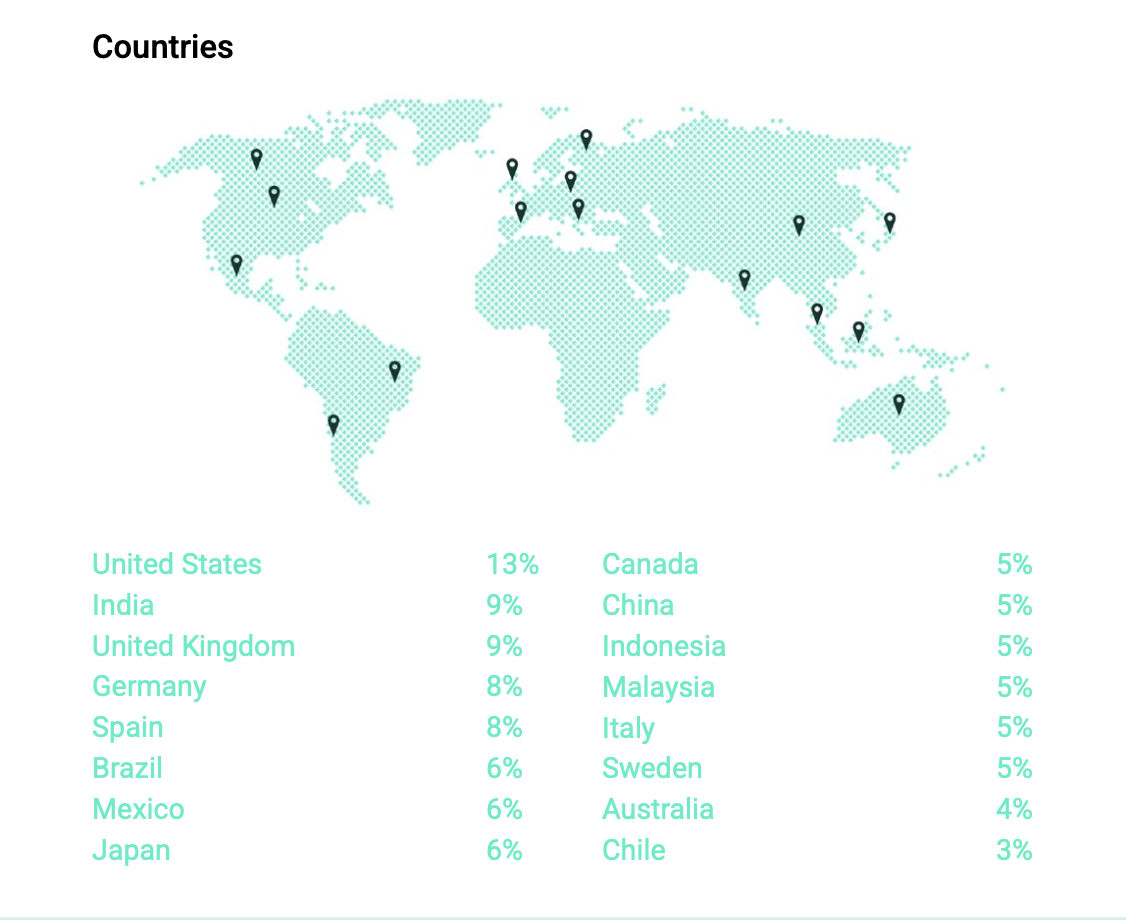 The respondent map — note the empty African continent and absent Russia. Source: 2026 Energy Efficiency Investment Report.
First — the geography. Africa and Russia are essentially absent. The country breakdown leans heavily on North America, Western Europe, and parts of Asia-Pacific. That’s a real omission. Africa is one of the fastest-growing energy demand regions on the planet, with some of the most urgent efficiency and access challenges anywhere — and a leapfrog opportunity in digital metering that mature markets can’t replicate. Leaving it out doesn’t just under-represent a continent; it misses where some of the most interesting efficiency stories of this decade are going to come from. My recommendation to the authors: bring African and Russian-region data into the next edition. A truly global efficiency report should look global.
Second — the size bias. By my read, the sample is weighted heavily toward organizations with turnover above $100M — roughly 95% of the respondents. That skews the entire picture toward enterprises with capital, dedicated energy teams, and audit budgets. But the volume of the economy — and the volume of wasted energy — sits in the long tail below that line: the SMEs, the single-site operators, the facilities with no energy manager at all. Those organizations face the exact same 23% cost exposure with a fraction of the tools. Including them wouldn’t just be more inclusive; it would make the findings far more representative of how energy is actually consumed.
The bottom line
Strip away the percentages and the trend is simple and, I think, irreversible: energy has moved from the facilities team to the finance team. It’s a cost-control problem now, a resilience problem, a data problem. The organizations that win the next few years will be the ones that can see their energy in real time and act on it fast enough to clear a two-year payback.
That shift is the whole reason this work matters to me. If the report does one thing, let it be this — go read it, then go look at your own data and ask whether you can actually see what 23% of your operating cost is doing.
📄 Read the full 2026 Energy Efficiency Investment Report → https://lnkd.in/d7PDZk9Y